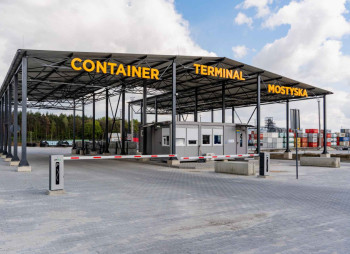
Swiss company Medlog SA, the logistics arm of global container shipping giant Mediterranean Shipping Company (MSC), has acquired stakes in two key Ukrainian logistics assets. In May 2025, Medlog purchased 50% of intermodal logistics operator N’UNIT, founded by Yehor Hrebennikov, as well as 25% of the cross-border Mostyska terminal, half of which is owned by Rinat Akhmetov’s Lemtrans. Negotiations over the transaction lasted about a year.
Forbes experts estimate the value of the assets acquired by Medlog at $15–30 million. Following the deal, Hrebennikov’s stake in N’UNIT decreased to 50%, while his interest in Mostyska fell to 25%. The remaining half of the cross-border terminal continues to be owned by Lemtrans.
MSC is a privately owned, family-controlled shipping company founded in 1970 and ranks as the world’s second-largest container carrier after A.P. Moller–Maersk Group. The company operates around 900 vessels and transports 27 million TEU annually across 520 ports worldwide. Medlog, as part of the MSC Group, operates in 90 countries and handles approximately 7.3 million TEU per year.
The N’UNIT network, founded by Hrebennikov in mid-2020, as of May 2025 included four rail-road terminals located in Vyshneve near Kyiv, Kharkiv, Dnipro, and Lviv region, as well as pallet and grain warehouses in Kharkiv. In 2024, N’UNIT’s revenue grew more than 2.5 times to UAH 2 billion, according to Opendatabot.
The Mostyska Dry Port (MDP) cross-border terminal began construction in 2021 by Lemtrans and its partner as part of the Container Terminal Mostyska project. The terminal is located on the site of a former oil depot near the Mostyska-2 railway station, just a few kilometers from the Ukraine–Poland border. A key feature of MDP is its dual-gauge rail infrastructure, with both 1,520 mm and 1,435 mm tracks. In 2024, the terminal increased revenue by 18% to UAH 388.9 million.
The transaction represents the first major investment by a multinational logistics player in Ukraine since the start of the full-scale war, underscoring the country’s strategic importance in global logistics supply chains.