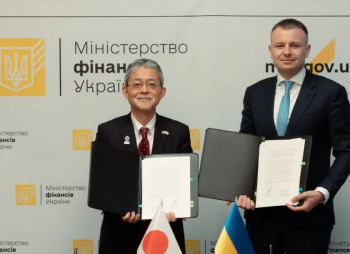
Ukraine and the Group of Creditors of Ukraine, which includes the G7 countries and members of the Paris Club, have signed a memorandum suspending debt service payments that were due from February 2026. The document was signed by Finance Minister Serhii Marchenko and representatives of Canada, France, Germany, Japan, Italy, the Netherlands, the United Kingdom, the United States, and South Korea. Under the memorandum, both interest payments and principal repayments have been deferred until the end of February 2030.
An important detail highlighted in official statements by European creditors is that the new arrangement not only extends the decisions made in 2022 and 2023, but also applies to debt incurred after the end of July 2022 and up to November 26, 2025. The Group of Creditors of Ukraine stated directly that the memorandum constitutes the first phase of the financial assurances provided by creditors for the approval of the new four-year IMF program, which was approved on February 26, 2026.
Once the deferral period ends, Ukraine will not avoid repayment altogether: the deferred amounts are to be repaid in equal semi-annual installments during 2035–2039, while interest accrued during this period will be capitalized. The IMF has clarified that the creditor group, which holds the majority of Ukraine’s official bilateral debt, agreed to a two-stage approach: first, an extension of the standstill, and then a final debt treatment after the exceptionally high uncertainty has diminished. Creditors also called on other official and external commercial creditors to provide Ukraine with terms at least as favorable.
For investors, this decision primarily means not debt cancellation, but the purchase of time for the budget and external liquidity. The new $8.1 billion IMF program is intended to serve as an anchor for a broader international support package totaling $136.5 billion for 2026–2029. According to the Fund’s estimates, Ukraine’s financing gap in 2026 alone amounts to $52 billion and is expected to be covered through IMF resources, EU mechanisms, G7 funds, and bilateral support. Reuters also cited Serhii Marchenko as saying in Washington that Ukraine’s 2026 financing needs would be covered once a major EU package is disbursed, while discussions regarding 2027 are still ongoing.
In numerical terms, the decision appears logical against the backdrop of Ukraine’s debt dynamics. In the IMF’s baseline scenario, Ukraine’s public and publicly guaranteed debt is projected to reach 110.4% of GDP in 2026. At the same time, the Finance Ministry’s medium-term debt strategy, approved in late 2025, estimated sovereign debt payments in 2026 at UAH 1.17 trillion, or 11.3% of GDP, while the average annual debt service burden in 2025–2028 was projected at UAH 1.193 trillion. This is why the extension of the standstill directly frees up resources for defense, social spending, and economic support.
In effect, the current agreement closes another segment in the broader reshaping of Ukraine’s debt profile. In 2024, the country had already restructured approximately $20.5 billion of Eurobonds, which, according to the Finance Ministry, reduced debt payments by $11.4 billion in 2024–2027 and by $22.8 billion through 2033. At the end of 2025, Ukraine also completed the exchange of $2.6 billion in GDP warrants, after which S&P upgraded the sovereign rating to CCC+ from SD. In other words, the current decision concerns official bilateral debt specifically and reinforces the view that the coming years for Ukraine will not be about returning to the market, but about maintaining macro-financial stability through international support and a managed debt profile.