To successfully attract investment for your project, it is worth listening to the recommendations of professional investment firms and advisors. Such teams have hands-on experience supporting dozens and hundreds of deals, can realistically assess a project’s investment attractiveness, understand investors’ expectations, and have working channels of access to capital.
Before you start actively searching for investors, it is critically important that you already have:
-
a clearly formulated business idea and a structured business plan;
-
an understanding of the required investment amount, funding stages, and timelines;
-
a transparent explanation of what exactly the raised funds will be used for and what economic impact it will generate.
For many entrepreneurs, asking for funding is a psychologically challenging step. Rejections are a normal part of the process: even strong projects hear dozens of “no” before they find the right investor. In 2026, investors have become even more selective, but at the same time the number of alternative capital-raising channels has increased.
In practice, finding an investor almost never looks like one clear step or a quick deal. In most cases, it is a process that combines project preparation, systematic communication, and the gradual building of investor trust. That is why an effective fundraising effort should be viewed not as a one-time action, but as a set of parallel channels that work simultaneously.
1. Startup launch platforms
Specialized online platforms have been created for first-time entrepreneurs to support every stage of a startup launch—from the idea and market research to communication with investors.
AngelList — one of the best-known global platforms for startups and business angels. It is used as a venue for initial introductions between founders and investors, and also for launching syndicates and funds. Most effective for early-stage startups (pre-seed, seed), especially in tech.
Gust — a platform focused on interaction with angel networks and funds. It is often used by accelerators and incubators to accept applications. For startups, Gust is convenient as a tool for structured presentation of the team, product, and financials.
OpenVC — a service for targeted search of venture investors. It positions itself as a database of verified VCs with filtering by industry and stage. In practice, it is used as a supporting tool for preparing personalized outreach.
Start Engine — a U.S. investment platform that provides access to carefully selected startups for business angels and accredited investors.
Today, Ukraine effectively lacks full-fledged online investment marketplaces focused on Ukrainian assets, except for InVenture. In this context, InVenture remains a unique platform combining a public online catalog of investment opportunities, an analytics media outlet, and professional deal support. The platform works with local and international investors, startups, scaling-stage businesses, and investment projects in the real economy.
2. Business angel networks
The key advantage of angel investing is not only capital, but also expertise, mentorship, and access to networks. Angels often engage actively in a project’s development, help avoid strategic mistakes, and open doors to new markets.
International platforms for finding angels:
-
Angel Capital Association — the largest industry association of business angels in the U.S., bringing together hundreds of angel groups and private investors.
-
UK Business Angels Association — the UK’s national association coordinating angel groups and private investors.
-
Angel Investment Network — an international online network connecting startups with private angels across different countries.
-
Keiretsu Forum — one of the largest private angel networks in the world, with offline and online communities in the U.S., Europe, and Asia.
-
European Business Angels Network (EBAN) — a pan-European association bringing together national angel networks and investors across the EU.
-
TCA Venture Group (TCA) / Tech Coast Angels — one of the largest regional angel networks in the U.S., focused on tech startups.
-
Startup Grind — a global community of entrepreneurs and startups; useful for networking, learning, and first contacts with mentors and investors.
Several business angel communities also operate in Ukraine:
-
iClub — a Ukrainian community of private investors that unites business angels for co-investing in early-stage startups and technology companies.
-
Toloka — a Ukrainian angel network focused on supporting startups through mentorship, networking, and early investments.
For preliminary analysis of investors and competitors and for fundraising preparation, we recommend using AngelList and Crunchbase, which contain data on tens of thousands of private investors and funds.
3. Crowdfunding platforms
Crowdfunding remains an effective tool for raising funds, testing demand, and building an initial community around a product.
International crowdfunding platforms:
Kickstarter — crowdfunding for launching product and creative startups. More often used to validate demand and build an initial audience than for classic investment.
Indiegogo — a flexible alternative to Kickstarter with the ability to launch campaigns without a rigid financial goal; suitable for experimental products and MVPs. Indiegogo is popular for creative or product-based projects.
Seedrs — a European equity crowdfunding platform where investors receive a stake in the company. Widely used in the UK and EU at pre-seed/seed stages.
OurCrowd — an international equity crowdfunding platform connecting startups and tech companies with accredited investors for co-investment.
Invesdor — a European investment and equity crowdfunding platform enabling both private and professional investors to invest in startups and businesses across the EU.
In Ukraine, it is worth considering Spilnokosht, which works well for social, creative, and technology projects.
4. Business incubators and accelerators
Incubators and accelerators are not just funding—they offer comprehensive support: mentorship, access to experts, legal and financial guidance, and networking.
The most popular and well-known international accelerators:
-
Y Combinator — one of the most famous accelerators. Online application, an intensive program, and Demo Day often become a launchpad for raising global venture capital.
-
500 Global — a global venture capital platform and accelerator programs (formerly 500 Startups), focused on early stages and international scaling.
-
Techstars — an international network of accelerator programs with a strong mentorship component and access to local investor ecosystems.
-
F6S — a platform for participating in accelerators, competitions, and grant programs; often used as a “single startup profile” for applications.
-
Seedcamp — a European seed accelerator and venture fund that supports early-stage tech startups with mentorship, networking, and access to international investors.
In the Ukrainian context, sector-specific accelerators (defence-tech, agri-tech, AI, health-tech) and programs with international participation are becoming increasingly important.
-
1991 Accelerator — a Ukrainian accelerator supporting startups at the intersection of technology, public services, and social impact.
-
Radar Tech — a corporate accelerator partnering with large businesses across retail, fintech, mobility, and telecom.
-
Sigma Software Labs — an incubator at Sigma Software focused on tech startups and early-stage product development.
-
iHub — a network of incubators for startups and entrepreneurs offering mentorship, learning programs, and a community for early projects.
-
Sikorsky Challenge — a university startup ecosystem at KPI combining incubation, acceleration, and innovation competitions.
-
UNIT.City — an innovation park in Kyiv with accelerator programs, startup schools, and access to investors and corporates.
-
Startup Ukraine — an educational platform and incubator helping entrepreneurs launch and scale businesses through training programs and mentorship.
5. Government and international programs and grants
Official business support in 2026 remains an important source of non-dilutive funding. This may include grants, concessional loans, and co-financing programs for innovation, exports, or economic recovery.
Although such programs rarely take on high risk, they work well for:
-
early stages;
-
R&D;
-
socially significant and infrastructure projects;
-
defence-tech.
Ukrainian Startup Fund — a state grant program providing pre-seed and seed funding to innovative startups without taking equity.
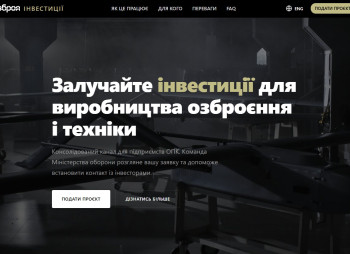
Brave1 — a state support platform for defence-tech and dual-use projects, combining grants, testing, customers, and access to military expertise.
eRobota — a government grant program for SMEs aimed at launching and scaling manufacturing, processing, and service projects.
Horizon Europe — an EU program involving Ukrainian companies and R&D teams, financing scientific and technological projects without equity dilution.
6. Professional social networks and networking
Professional social networks and networking remain one of the most effective—and least formalized—ways to find an investor. Unlike investment platforms where a startup competes with hundreds of other projects, a personal or semi-personal connection significantly increases the chance of being heard. That is why LinkedIn today effectively serves as a global networking hub for investors, venture funds, business angels, and top executives.
In practice, LinkedIn is used not only for “cold” messages but also for building trust over time: through posts about product progress, comments in industry discussions, and engagement with mutual connections. Investors often pay attention not only to the pitch itself, but also to how a founder thinks, communicates, and articulates a business vision publicly. Therefore, an active and professional LinkedIn presence can work as a long-term tool for preparing for fundraising.
Offline and hybrid networking formats also play a role—industry meetups, startup gatherings, business breakfasts, and conferences. Event platforms like Meetup often become places where investors meet projects informally, without a classic pitch or presentation. In such environments, decisions about further communication are often made not on the basis of a financial model, but through personal trust, recommendations, and live interaction.
Which other social networks are worth considering?
X — an informal but influential network where VCs, founders, and analysts actively discuss deals, trends, and new projects.
Telegram — a popular platform for industry investor and startup chats where connections are often formed through recommendations and direct conversations.
Discord — an environment of closed startup and VC communities, especially common in Web3, gaming, and developer-oriented projects.
Slack — a tool for closed professional communities and accelerator networks where startups access investors through internal channels.
Indie Hackers — an international founder community where early-stage startups share experience and attract angel attention to bootstrapped projects.
Product Hunt — a public startup launch platform enabling early feedback and investor attention.
Reddit — thematic communities (r/startups, r/venturecapital) for informal discussions around investment and fundraising.
7. Direct investment and private equity
Private equity funds and family offices typically work with more mature businesses—those with stable revenues, an established team, and a clear scaling model. Unlike venture investors, they focus less on the idea and more on predictable cash flows, operational efficiency, and potential value growth.
These investors may enter with checks from hundreds of thousands to several million dollars, often acquiring a significant stake or control. Their strategic goal is active participation in business development, scaling through organic growth or M&A, and exiting within 3–7 years via a sale to a strategic investor or another fund. For entrepreneurs, this is not only capital but also access to management expertise, financial discipline, and international connections.
8. Online lending and alternative finance platforms
Due to strict bank requirements for collateral, credit history, and financial reporting, startups and small businesses increasingly turn to alternative financing tools. These include P2P lending, online funds, factoring services, and specialized SME platforms that make decisions faster and more flexibly than traditional banks.
Such instruments are best suited for projects with predictable cash flows, active contracts, or recurring revenues—when funding is needed for working capital, marketing, or scaling. At the same time, entrepreneurs should consider the higher cost of capital and stricter repayment terms, since alternative financing is rarely designed for long-term innovation risk.
Here are popular online lending and alternative finance platforms/services in Ukraine that entrepreneurs and small businesses may consider as sources of short-term or working-capital financing:
NovaPay (business loans) — in the NovaPay app, entrepreneurs can obtain online loans within certain limits with relatively transparent repayment terms.
FinStream — a service that helps businesses obtain financing and loans, including for sole proprietors (FOPs) or agribusiness via online requests.
Moneyveo — a Ukrainian fintech micro-lending company offering fast online loans without the need to visit a bank branch.
Cashberry — a digital platform specializing in issuing quick online microloans to a card with a simple application process.
LoanExpert — an online lending service enabling fast, 24/7 loans with a streamlined approval process, aimed at a broad user base.
ensun
CC Loan — a well-known Ukrainian company in the online loan segment offering microloans on simplified terms.
Wikipedia
MoCash — a Ukrainian P2P lending platform connecting private borrowers and investors to finance peer-to-peer loans.
9. Self-driven marketing and personal brand
A strong founder’s personal brand is increasingly becoming one of the key trust factors for investors. Active and consistent presence in media, social networks, professional communities, and public events allows founders to demonstrate expertise, market vision, and strategic thinking even before formal pitching.
In practice, investors often come to a project not through a deck, but through the founder’s public reputation—comments, analytics, case studies, or participation in industry discussions. This approach does not replace classic fundraising, but it significantly lowers the barrier for the first contact and increases the probability of interest even without active outreach.
10. Friends & Family
Investment from one’s close circle often becomes the first financial step for a startup or new business, especially at the idea or MVP stage. This format allows founders to raise seed capital quickly when access to professional investors is still limited or the project is not ready for external pitching.
At the same time, such investments require maximum transparency and formalization: written agreements, clear explanation of risks, and understandable expectations regarding repayment or equity participation. Separating personal and business relationships early helps avoid conflicts and preserve trust regardless of future project outcomes.
Summary
Finding an investor is not a one-time action, but a consistent process that rarely delivers results on the first attempt. Rejections or lack of interest at the start do not mean the project is weak—most often it signals the wrong timing, channel, or pitch format. Every investor interaction is part of learning and refining your investment proposition.
Practice shows that the best chances of success belong to teams that combine strong preparation, strategic thinking, and systematic work across multiple funding channels simultaneously. In today’s environment, winners are not those who simply look for money, but those who understand investor logic, can adapt to the market, and build long-term investment relationships. This approach turns fundraising from a matter of chance into a managed process and significantly increases the likelihood of raising capital.
How to find an investor for a project in Ukraine? Top ways to find an investor online. How to look for an investor for a startup? Where to find investment? Attracting investors for business. Investment platforms 2026. Business angel networks. Accelerators and startup programs. Crowdfunding for startups. Government grants for business. Finding an investor for a project. Where to look for an investor: platforms and networks. Finding investment on LinkedIn. Government grants. Investors for a startup—where to look for funding? How to find an investor in Ukraine. Where to find an investor for a business. Where to look for an investor? Finding an investor for a startup. How to attract investment for a business? How to get investors’ attention? Investment for Ukrainian startups. What to do if an investor is not interested. Fundraising for startups. How to attract investors in Ukraine? Startup investors.