In peacetime, the phrase “best investment” is usually associated with real estate, stocks, or startups. However, in the conditions of a full-scale war, Ukraine is forced to rethink what a profitable allocation of capital actually means. Today, the highest return is generated not by buying apartments or businesses, but by supporting defense initiatives capable of delivering tangible damage to the aggressor.
From the standpoint of public good and national security, the prospects for rebuilding Ukraine’s economy and any private business, support for defense initiatives through donations for drones delivers the highest “ROI” — returns in the form of saved lives, a weakened enemy economy, and increased chances of victory.
Why Oil Refineries Are the Target
Oil refineries are one of the key pillars of Russia’s economy.
-
Source of revenue: Russia earns billions from exporting petroleum products, using these funds to finance the war.
-
Military logistics: Fuel is a critical resource for tanks, aircraft, and missiles. Disabling refineries disrupts army supply chains.
-
Psychological impact: Explosions deep inside Russian territory create a sense of vulnerability and shatter the myth of “invulnerability.”
Every successful drone strike on an oil refinery therefore represents not only destroyed infrastructure, but also a strategic setback for the enemy.
Depending on the valuation methodology, 21% of Russia’s oil refining capacity corresponds to approximately $70–75 billion in losses. In terms of foregone revenues, 21% of Russian refining equals about 1.13 million barrels per day × $62 (Urals) per barrel ≈ $70 million per day, or $25.5 billion per year.
Ukraine’s Strikes on Russian Oil Refineries
Since early August, Ukraine has intensified strikes against oil refineries inside Russia. These facilities supply fuel to the civilian population and to Russian army groupings involved in the full-scale invasion.
The strikes — followed by temporary shutdowns of refineries — coincided with peak gasoline consumption in Russia, driven by the tourist season and agricultural activities.
As of late August 2025, Ukraine has collectively disabled 21% of Russia’s oil refining capacity. Among the latest attacks by Ukraine’s Unmanned Systems Forces under the command of Robert “Madyar” Brovdi, together with the Main Intelligence Directorate, were strikes on the Kuibyshev Refinery in Samara Oblast (7 million tons of refining capacity, or 2.5% of total Russian refining) and the Afipsky Refinery in Krasnodar Krai (6.25 million tons, or 2.2%).
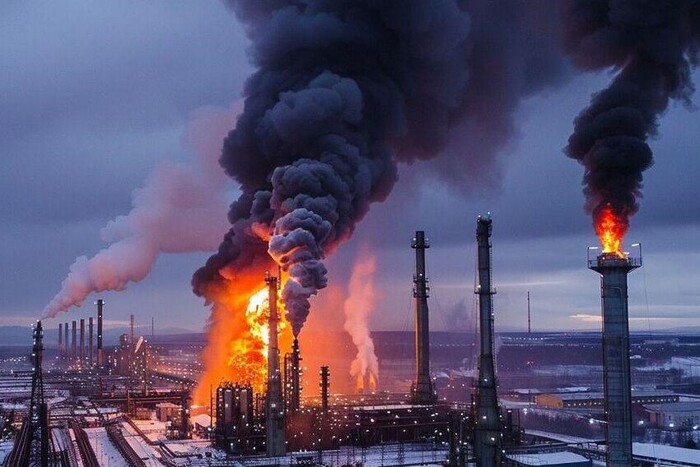
Today, gasoline shortages affect all territories under Russian occupation in Ukraine, including Crimea, as well as southern Russia and the Far East.
Donations as an Investment With Maximum ROI
In financial terminology, an investment is evaluated by ROI (return on investment) — the ratio of funds invested to benefits received.
-
Classic investment: $1,000 invested in a business may generate returns of a few tens of percent over several years.
-
Donation for drones: the same $1,000 can help purchase UAV components that destroy fuel storage worth millions of dollars.
Thus, the effectiveness of a “donation investment” is measured not by personal financial gain, but by benefits for the entire country — bringing victory closer and reducing the aggressor’s resources.
After the war, Ukrainian businesses will simultaneously benefit from rising domestic demand, access to external markets, investment capital, and state support. This unique combination will create conditions for dynamic growth across almost all sectors — from agribusiness and manufacturing to technology and infrastructure.
Scenarios in Which Russia Loses 50%, 70%, and 90% of Oil Refining and Transportation Capacity
1. Loss of 50% (Partial System Paralysis)
Military-political factors
-
Massive drone and precision missile strikes on key refineries (Volga region, Moscow area, Urals).
-
Major refineries taken offline (Ryazan, Nizhnekamsk, Kirishi).
-
Tighter sanctions: a complete ban on equipment, technology, and catalysts for cracking and hydrotreating.
Technical consequences
-
Half of refineries shut down due to fires, accidents, or lack of repair equipment.
-
Disruptions to the Druzhba pipeline system and partial destruction of Transneft facilities.
Economic effect
-
Refining falls from ~260 million tons/year to ~130 million tons.
-
Petroleum product exports drop by 40–50%.
-
Annual foreign currency revenue declines by $90–100 billion; the budget loses at least 5–6 trillion rubles.
-
Fuel shortages and rising prices, though minimal system stability remains.
Impact on daily life
-
Gasoline and diesel prices increase 2–2.5×.
-
Fuel supply disruptions in remote regions (Siberia, Far East).
-
Food and logistics costs rise 20–30%.
-
Minimal stability persists in major cities (Moscow, St. Petersburg).
2. Loss of 70% (Deep Energy Crisis)
Military-political factors
-
Systematic strikes across the refinery network and transport hubs, including Black Sea ports (Novorossiysk, Tuapse).
-
Damage to key trunk pipelines (Baltic Pipeline System, Eastern Siberia–Pacific Ocean).
-
Exit of India and China due to secondary sanctions blocking tanker access and insurance.
Technical consequences
-
Two-thirds of refineries inoperable due to lack of catalytic systems, equipment, and chemicals.
-
Ports unable to export oil due to infrastructure damage and blockades.
-
Rail logistics unable to compensate for losses.
Economic effect
-
Refining drops to ~70–80 million tons/year.
-
Crude oil exports fall by more than half.
-
Chronic domestic fuel shortages; rationing systems introduced.
-
Revenues fall from $180–200 billion to $50–60 billion per year (a loss of $120–140 billion annually).
-
GDP declines by 10–15% in a single year; budget deficit reaches 10–12 trillion rubles, forcing money printing.
Impact on daily life
-
Fuel rationing: drivers can purchase limited liters per week.
-
Aviation fuel shortages cut domestic flights by 50–60%.
-
Widespread supply disruptions, empty shelves in remote cities.
-
Inflation rises to 30–40% annually.
-
Mass protests in low-income regions.
3. Loss of 90% (Collapse of the Energy System)
Military-political factors
-
Complete shutdown of most refineries due to combined strikes (drones + missiles + cyberattacks).
-
Destruction or blockade of key export ports (Novorossiysk, Primorsk, Ust-Luga).
-
Sanctions escalate to embargo levels: confiscation of Sovcomflot’s tanker fleet; bans on third countries purchasing Russian oil.
Technical consequences
-
90% of refining halted; refineries turn into scrap metal due to lack of repair capabilities.
-
Transneft loses control over trunk pipelines; exports collapse.
-
Only limited fuel imports from China and Iran remain.
Economic effect
-
Refining falls from ~260 million tons to <30 million tons/year.
-
Russia loses 60–70% of foreign currency revenues from energy exports; oil and petroleum export revenues fall from $180–200 billion to under $20 billion per year.
-
Budget deficit reaches 20–25% of GDP (≈$400–450 billion); the ruble devalues 5–10×; hyperinflation exceeds 100% annually.
-
Domestic fuel market collapses, disrupting agriculture and transport, partially paralyzing the economy.
Impact on daily life
-
Massive gasoline and diesel shortages; fuel reserved only for the army and strategic sectors.
-
Transport collapse: buses and trucks idle, agriculture halted (no sowing or harvesting), railways operate at limited capacity.
-
Shortages of food, water, and medicine in cities.
-
Blackouts due to lack of diesel generators and infrastructure failures.
-
Sharp rise in mortality, social chaos, mass migration from regions to Moscow and abroad.
-
De facto loss of “energy superpower” status.
Social Impact: Unity and Responsibility
Another important aspect is social cohesion. Donations for drones have become a form of grassroots investment in collective security. Every Ukrainian can feel involved: even a small contribution of a few hundred — or better, a few thousand — hryvnias becomes part of a major victory. This strengthens trust and solidarity in society, a resource no less important than money.
Of course, donations to medicine, humanitarian aid, or infrastructure reconstruction are vital. But in terms of short-term and strategic impact, strikes on oil refineries are uniquely effective. They paralyze the enemy “here and now” while saving Ukraine’s resources in the future.
Madyar and the Drones
The callsign Madyar is well known to many Ukrainians. He is an aerial reconnaissance commander who has been developing drone technologies for the military since 2014. After 2022, his work became public: he regularly launches fundraising campaigns for UAVs, demonstrates strike results, and reports transparently to society. Transparency and trust are precisely why thousands of people donate to his campaigns without hesitation.

“Gasoline is becoming a scarce liquid, while gas and oil are becoming fast-burning,” — Robert Brovdi.
For some, the phrase “Donations to Madyar for drones are the best investment” may sound provocative or like an ironic metaphor, but it perfectly captures the spirit of the time. Today, every hryvnia invested in defense works like a million invested in the future — in saved lives, safer cities, and the possibility to once again invest in peaceful projects.
At InVenture, we regularly support fundraising campaigns by Robert Brovdi and his team and invite you to join the best investment — in your future and the future of coming generations. You can follow Madyar’s official Telegram channel for fundraising updates and striking footage of enemy destruction.
We are also happy to support founders of promising miltech projects in Ukraine in attracting investment.