



Project Location / Regional Focus
Kyiv, Ukraine.
The project is primarily focused on the Ukrainian market, with priority given to the needs of the Defence Forces of Ukraine, military units, government institutions, and charitable foundations.
In the future, the project envisages the possibility of scaling up production and entering the international market for unmanned ground platforms.
Brief Project Description
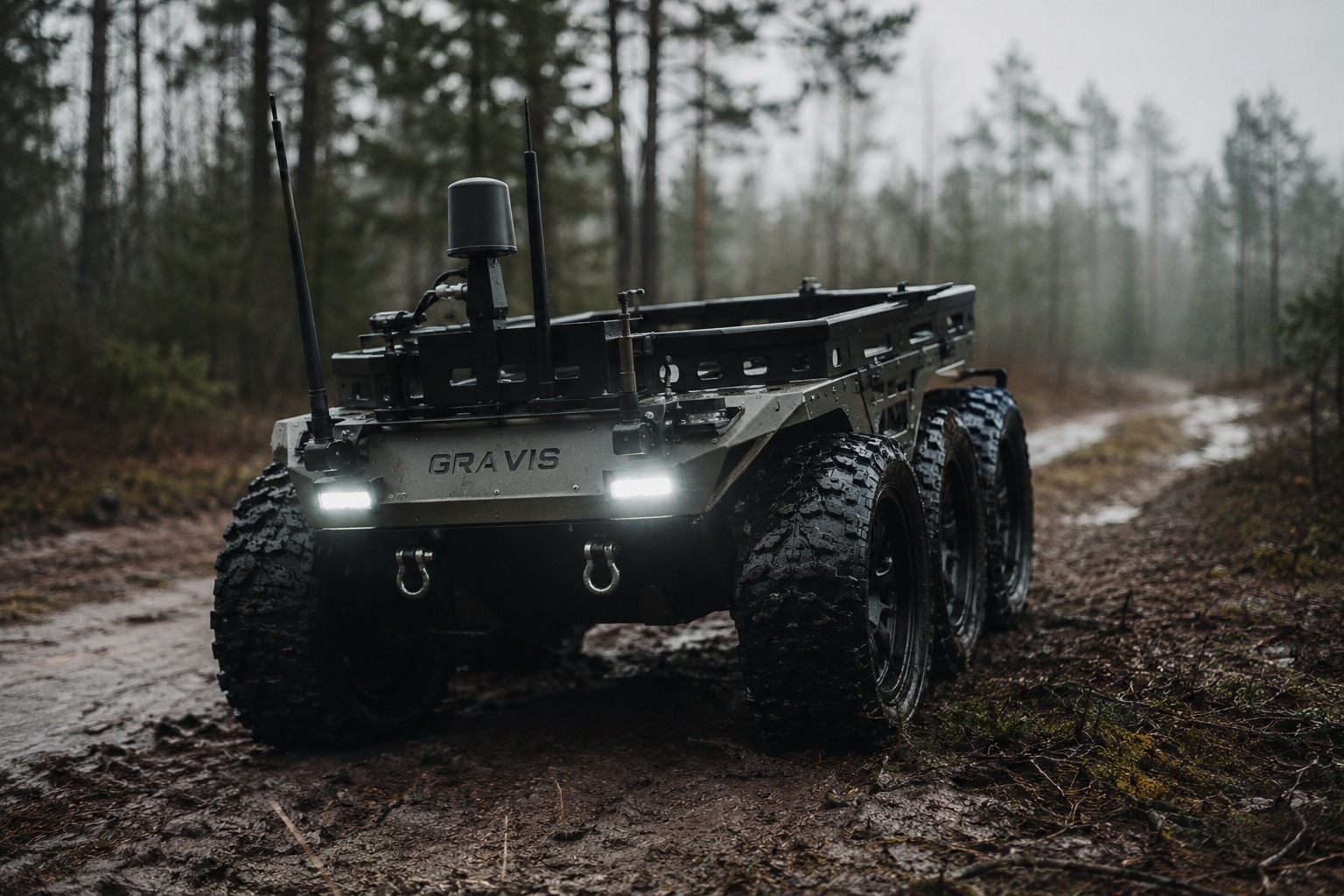
GRAVIS is a project focused on the development and serial production of a modular unmanned ground platform.
The platform’s primary purpose is to perform logistics tasks and transport cargo. Its modular architecture enables the base platform to be adapted to various use cases through the installation of specialised modules and equipment.
The core concept of the project is to create an affordable, reliable, and easily repairable unmanned ground system whose design is based on practical experience in operating robotic platforms under challenging field conditions.
Problem Statement
Existing unmanned ground systems often have a number of practical shortcomings, including high costs, complex repairs, dependence on specialised components, limited field repairability, and design solutions that do not always take into account the real-world experience of end users.
The project team has practical experience in operating unmanned ground systems produced by various manufacturers directly in frontline conditions, as well as experience in repairing, controlling, and modifying such systems.
This experience has enabled the team to identify the typical shortcomings of existing platforms not through theoretical analysis, but directly in the course of their practical use.
The GRAVIS project is being developed with these issues and the actual needs of operators in mind.
Proposed Solution and Product Information
The proposed solution is the development of a standardised modular unmanned ground platform with an emphasis on design simplicity, reliability, repairability, and cost efficiency.
The main planned specifications of the base platform are:
- payload capacity — up to 250 kg;
- operating range — up to 70 km;
- maximum speed — up to 20 km/h;
- platform weight — approximately 200 kg;
- modular design;
- remote-control capability;
- ability to integrate additional communication, navigation, video surveillance, and specialised equipment systems.
A key competitive advantage is that the product is being developed by a team with practical experience in using, repairing, and upgrading unmanned ground systems produced by various manufacturers.
Design decisions are made with actual operational challenges in mind, including repair speed, component availability, ease of maintenance, and the ability to adapt the platform to a specific task.
Brief Market Analysis
The unmanned ground systems market is undergoing active development. Ukraine has developed significant practical demand for robotic systems capable of performing logistics and other tasks remotely.
The main market trends include:
- increased use of unmanned ground systems;
- transition from individual experimental platforms to serial production;
- demand for affordable and scalable solutions;
- development of modular platforms;
- increased requirements for operational autonomy and range;
- the need for rapid repair and restoration of equipment.
The market potential is considered significant given the need for the large-scale deployment of robotic platforms and the regular renewal of equipment fleets.
Sales and Promotion
The main potential customers for the product include:
- military units;
- government institutions;
- charitable and volunteer foundations;
- organisations procuring technical equipment for the Defence Forces.
The project plans to use direct B2B and B2G sales, demonstrate the platform to potential customers, conduct practical trials, and provide prototype units for test operation.
The primary product promotion tool is expected to be the platform’s proven practical effectiveness.
At the current stage, no contracts have been concluded. Following completion of the base model, the project plans to actively engage with potential customers and conduct demonstration trials.
Key Suppliers and Contractors
The production process uses components and materials of Ukrainian and foreign origin.
The main supply categories include:
- electric motors and control systems;
- battery components;
- electronics;
- communication and navigation systems;
- metal and structural materials;mechanical components;
- metalworking services and the manufacture of individual parts.
One of the project’s principles is to minimise dependence on any single supplier and to use readily available components that can be quickly replaced with alternatives.
Current Stage of Project Development
The project is currently at the development and prototyping stage of the new modular platform.
The team has previously developed and tested prototypes of unmanned ground systems with different designs.
The team has accumulated significant practical experience in:
- operating unmanned ground systems produced by various manufacturers;
- controlling robotic platforms;
- repairing unmanned ground systems;
- upgrading and modifying platforms;
- analysing the design shortcomings of existing solutions.
Part of this experience was gained directly in frontline conditions.
The next stage of the roadmap is to manufacture a fully functional GRAVIS prototype, conduct a comprehensive testing programme, eliminate identified shortcomings, and prepare the design for low-volume production.
Following completion of this stage, the project plans to reach a production capacity of 20–30 units per month.
Asset Information
The project is being implemented in leased production premises.
The team owns equipment and tools sufficient for the development, assembly, and prototyping of unmanned ground platforms.
The available material and technical resources make it possible to perform:
- prototype assembly;
- installation of electronic systems;
- integration of drive units and control systems;
- repair and upgrading of unmanned ground systems;
- basic technical testing.
Further expansion of the production base is planned in order to transition to serial production.
Team and Personnel
At the current stage, the project team consists of four people.
The team’s key competence is the combination of technical experience in developing and repairing unmanned ground systems with a practical understanding of how such systems are operated by end users.
The project founder is directly involved in the technical development, testing, repair, and upgrading of robotic platforms.
A particular area of expertise is the practical experience of using unmanned ground systems produced by various manufacturers in frontline conditions. This makes it possible to define technical product requirements based on real-world experience rather than exclusively on laboratory or theoretical research.
Key Current and Target Project Indicators
The current stage is R&D and prototyping.
The target production capacity for the first stage is 20–30 platforms per month.
The main target indicators are:
- completion of the base prototype;
- validation of the stated technical specifications;
- completion of practical trials;
- preparation of the platform for serial production;
- receipt of the first orders;
- achievement of a production volume of 20–30 units per month.
The IRR, NPV, and exact payback period will be calculated after the serial production cost of the platform has been determined and the target selling price has been agreed.
Required Investment
The required investment at the current stage is USD 15,000.
The project is considering the involvement of a strategic or financial investor.
Possible forms of investor participation include:
- an equity stake in the company;
- participation in the project’s profits;
- a combined investment model.
The specific terms and format of investor participation are open for individual discussion.
An investor with expertise in scaling production, working with government or corporate customers, and developing technology projects would be considered an advantage.
Investment Budget
The primary use of the raised investment will be the purchase of components and materials required to manufacture fully functional platform prototypes.
The investment is planned to be allocated to:
- the purchase of electric drive units and control system components;
- battery components;
- electronics;
- communication and navigation systems;
- metal and structural materials;
- mechanical components;
- the manufacture of specialised parts;
- prototype assembly and testing;
- the formation of an initial inventory of components.
A detailed investment budget may be provided to the investor separately.
Investment Already Made
To date, approximately USD 10,000 of the team’s own funds has been invested in the development of the technical base, prototyping, equipment, and product development.
The project has been developed primarily through the team’s own financing.
The additional USD 15,000 is required to accelerate the development of the new platform and move from the development stage to a fully functional prototype, followed by preparations for serial production.
Exit Opportunities
In the medium term, potential investor exit scenarios include:
- the sale of the equity stake to a strategic investor;
- the repurchase of the equity stake by the founders;
- the sale of the company or technology project to a larger manufacturer;
- the generation of returns through participation in the company’s profits.
Potential strategic buyers may include Ukrainian and international manufacturers of robotic systems, defence technology companies, and investment firms building portfolios of defence-tech projects.
