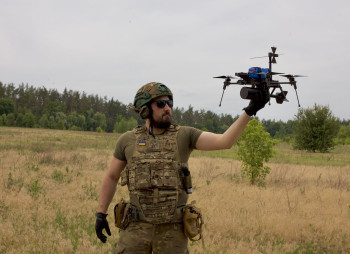
European defense company Stark, founded by Quantum Systems co-founder Florian Seibel, is opening an R&D center in Ukraine with an area of approximately 2,000 square meters, designed to accommodate more than 200 specialists. According to the company, the center will focus on research and development, systems integration, operator training, and technical support, and is expected to shorten the cycle “from prototype to serial production.”
According to the company and European defense-tech media reports, Stark views Ukraine as the most dynamic environment for testing and conducting daily technological iterations based on real combat data. The “combat-driven development” model enables:
- Rapid software and AI algorithm updates;
- Increased resilience to electronic warfare (EW);
- Adaptation of munitions for various operational scenarios;
- Accelerated certification and integration into NATO standards.
Stark Ukraine COO Maksym Cherkis stated that deterrence in Europe today depends not only on arsenals, but also on stable serial production and the ability to rapidly update systems.
Flagship Product: Virtus Loitering Munition
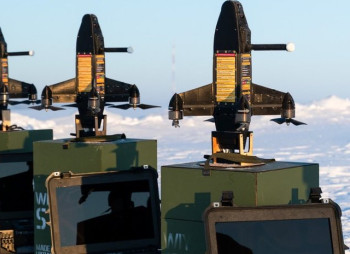
The Virtus loitering munition (OWE-V Virtus) is a VTOL platform featuring vertical take-off and landing capabilities and autonomous targeting algorithms.
Key specifications (based on publicly available company data):
- Warhead up to 5 kg (modular);
- Range of up to 100 km;
- Flight time of up to 60 minutes;
- Cruising speed of approximately 120 km/h, dive speed up to approximately 250 km/h;
- Weight of around 33 kg;
- Launch without a catapult from a prepared site;
- Operation without GPS and in active EW environments;
- Capability for return and swarm deployment;
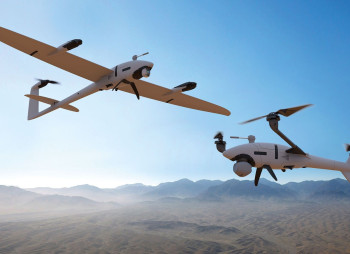
- Integration with reconnaissance UAVs, including Vector platforms by Quantum Systems.
According to industry reports, the first combat use of Virtus in Ukraine was recorded in 2025. In 2026, the company reported contracts with NATO countries and the expansion of its manufacturing presence in the United Kingdom.
Valuation Above €1 Billion and Positioning in the EU
Stark, established in 2024 by a group of German technology entrepreneurs (including Florian Seibel, Uwe Horstmann, and Johannes Schaback), positions itself as a European “new defense” player: AI-first, software-defined architecture, modularity, and a strong focus on EW resilience.
According to European industry sources, the company’s valuation exceeds €1 billion, placing it among Europe’s fast-growing defense-tech companies. Stark operates offices and/or production units in Germany, Sweden, Ukraine, and the United Kingdom, with its headquarters in Berlin.
What the Opening of the R&D Center Means for Ukraine
- Technological synergy. Access to European engineering expertise and supply chains, along with joint development of AI modules and EW-resilient systems.
- Shorter time-to-market. Daily iteration based on combat data reduces the cycle from design to serial production.
- Localization of competencies. Training of operators, integrators, and service teams in Ukraine.
- Production outlook. The company has declared its intention to expand its presence from R&D to full-scale UAV manufacturing in Ukraine.
The opening of Stark’s R&D center in Ukraine represents not only the expansion of a European manufacturer’s footprint, but also the institutionalization of a “combat experience + European industry” model. For Ukraine, this means an inflow of engineering expertise and integration into the European defense ecosystem; for Europe, it provides accelerated access to modern warfare practices and scalable technological solutions.