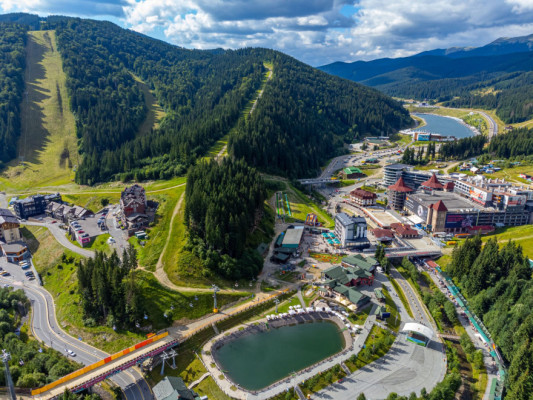

The 2025–2026 winter season became a test for the business models of tourism-driven real estate in the Carpathians: operators faced a surge in electricity, fuel, and labor costs, yet a number of projects managed to preserve investor payouts and even post revenue growth.
The market for income-producing tourism real estate in the Carpathians has entered a phase of practical verification. After the boom in apartment and cottage sales marketed as passive-income assets in 2022–2023, the 2025–2026 winter season was expected to show how viable the stated investment models really were. According to market participants, demand for leisure travel remained strong, but operator profitability came under pressure due to a sharp rise in costs.
The key challenge for the market was energy. Participants in the segment report that business electricity tariffs rose during the winter from UAH 7–9 per kWh in the autumn to UAH 13–15, and in certain hours to as much as UAH 17–18. At the same time, costs for generator fuel, utilities, wages, and food also increased. This meant that even with high occupancy at hotel complexes, some operators were working with significantly lower margins than initially planned.
Despite this, the season proved far more stable for retail investors than for the management companies themselves. In the Ulis.Vorokhta project, according to co-founder Ihor Farberov, the winter months were loss-making for the operator, but investors hardly felt the impact: investor income there rose by 25% year-on-year in the first quarter of 2026. At Fomich Residence, the company says investor payouts have been made without interruption for four consecutive years. At Apartel Resorts, investor income this winter was 11.6% higher than a year earlier, while on average an investor earned 9%–13% annually in U.S. dollar terms relative to the value of a single asset. Ribas Hotels Group says that around 50% of investors’ annual income is generated in winter, while dividend growth in the first quarter of 2026 was about 30% versus the same period of 2025.
For investors, this means that the real resilience of an asset depends not only on tourist traffic, but also on the revenue-sharing model between the property owner and the operator. Where the investor receives a fixed share of revenue or another protected payout mechanism, seasonal and operating risks are more concentrated on the management company. Where returns depend directly on net profit after expenses, investor outcomes are more sensitive to tariffs, seasonality, and management efficiency.
At the same time, the market remains far from fully transparent. A significant share of complexes that were actively sold to private investors in previous years have still not been commissioned and, accordingly, are not yet generating payouts. In addition, some operating properties, according to Forbes sources, are not making any payouts to investors at all due to weak occupancy, high costs, or flaws in the business model. Investment adviser and iPlan co-founder Liubomyr Ostapiv notes that actual returns in many cases appear moderate and often fall short of the promised 8%–11% annually. In one example he cited, apartments in a hotel in central Bukovel generated around 5% annually in U.S. dollar terms in 2025.
Thus, the winter season in the Carpathians did not break the market for income-producing real estate, but it clearly separated projects with a functioning operating model from those that still remain at the level of marketing promises. For new investors, this increases the importance of due diligence: the key factors are not only the property’s location and concept, but also the contract structure, payout mechanics, track record of actual dividends, and the operator’s ability to withstand periods of elevated costs without reducing income for the asset owner.