

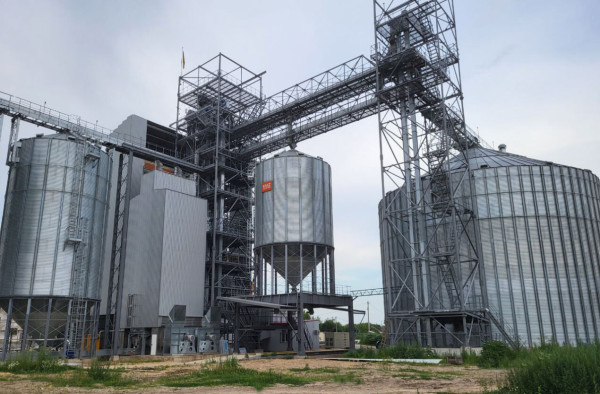

The case of more than 100,000 tonnes of missing grain at a third-party elevator, which the market associates with former Agriculture Minister Mykola Solskyi, could become a turning point for Ukraine’s entire grain logistics model. Following the scandal, some traders have already suspended purchases through third-party elevators, while agricultural producers are likely to increasingly redirect capital toward their own grain storage and drying capacities.
One of the most high-profile infrastructure scandals in Ukraine’s grain market in recent years is now unfolding. According to Latifundist, traders discovered a shortage of more than 100,000 tonnes of grain at the Volytsia-Agro elevator in Kyiv region, while market estimates already put the figure at 130,000–140,000 tonnes. Sources cited by the publication estimate the minimum losses at around $30 million. Companies reported as potentially affected include ADM, Louis Dreyfus Company, Cargill, Kernel, Epicentr, LNZ, Arista, MHP, and others.
The situation has already extended far beyond a single company. Mykola Horbachov, President of the Ukrainian Grain Association, said that some major traders have paused grain purchases through third-party elevators, while others are conducting internal reviews and reassessing their risk limits. According to him, whereas some market participants had previously considered 200,000–300,000 tonnes of external storage acceptable, some players may now reduce this threshold to 10,000–12,000 tonnes or abandon the practice altogether.
For farmers, this implies a change in the grain sales model itself. Previously, a producer could quickly deliver grain to the nearest elevator, sell it to a trader, and promptly receive working capital. That model is now losing its appeal. The Ukrainian Grain Association has directly warned that the flow of funds from grain companies to farmers will slow, while demand for credit financing will grow. Under such conditions, having one’s own grain storage facility or at least one’s own grain dryer becomes not just an infrastructure advantage, but also a financial instrument for protecting liquidity.
Against this backdrop, the market is already showing where investment demand is likely to move. In recent days alone, AST launched a new 70,000-tonne elevator in Lviv region, KLO AGRO commissioned its own 21,000-tonne elevator in Vinnytsia region with potential expansion to 60,000 tonnes, and in Sumy region a farming enterprise began construction of its own elevator after calculating that third-party drying services had cost it UAH 25–30 million in a single season. This indicates that for a growing number of players, investment in proprietary storage now has a clear economic logic — from controlling quality and cost to reducing counterparty risk.
Sale of a 30,000-tonne linear grain elevator in Vinnytsia region
Equipment manufacturers are also reporting that this trend is gaining momentum. According to the sector company Zernovyi Dim, Ukraine’s grain storage construction market grew steadily in 2025, with around 80% of orders accounted for by the expansion and modernization of existing facilities. The company also notes that 2025 reinforced the trend toward developing in-house grain drying capacity, especially where margin control in corn production depends on it.
It is telling that the issue of proprietary storage is now also being supported by state and international programmes. At the beginning of 2026, Ukraine’s Ministry of Economy, together with the FAO, launched a programme to provide modular grain storage units to Ukrainian farmers. The initiative involves units with a capacity of 1,000 tonnes each and a total potential storage capacity of up to 100,000 tonnes. The government has explicitly explained that the programme is intended to reduce post-harvest losses, cut logistics costs, and give producers more control over the timing of grain sales.
As a result, the Volytsia-Agro scandal may accelerate a reassessment of risk across the entire grain trading chain. If investment in one’s own elevator was previously seen mainly as a growth tool, it is now increasingly being viewed as insurance against loss of product, delays in sales, and shortages of working capital. In the coming quarters, this could push farmers, traders, and vertically integrated groups toward a new wave of investment in proprietary elevators, dryers, modular storage, and other elements of controlled logistics infrastructure.
