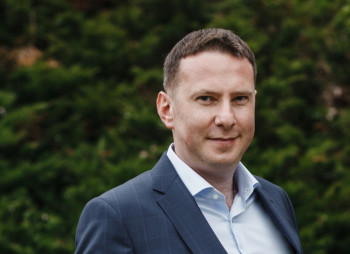
Tomas Fiala’s investment company, Dragon Capital, currently holds around 50 investments, with assets under management reaching $1 billion. Dragon Capital is one of Ukraine’s largest commercial property owners, with a real estate portfolio totaling 640,000 sq. m, including six shopping malls, 11 office centers, and 10 logistics complexes.
Dragon Capital’s investment portfolio also includes Unex Bank and a number of manufacturing companies, ranging from the Karlivka Machine-Building Plant to the producer of Truskavetska mineral water. Dragon Capital also owns two of Ukraine’s largest media groups by audience reach — Ukrainska Pravda and NV.
We have selected the most important business and investment principles shared by Tomas Fiala.
I value freedom. Money provides more opportunities to be free.
Before 1989, in Czechoslovakia, your career did not really matter unless you were a member of the Communist Party. Everyone earned roughly the same amount.
I was a member of the Czechoslovak national sailing team and, from the age of 13, traveled to Western countries with the team. I saw how people lived in Sweden, Germany, Austria, and Italy. Whenever I returned to Czechoslovakia, I felt slightly depressed.
I could see that free-market economies and democracies were much more successful. People lived better than we did. That is why, during the socialist era, I was motivated to pursue sports — it gave me an opportunity to travel abroad.
Mathematics is the most useful subject.
Without mathematics, it is difficult to calculate things quickly. It does not necessarily have to be advanced mathematics — I have never really found a practical use for integrals.
After 1989, many more opportunities became available, so I focused on education. I studied foreign languages, went abroad to study in Germany, and spent a year living with a German family. During my final two years of high school, I worked as a German-language translator.
When I enrolled at the University of Economics in Prague, I studied macroeconomics, business economics, corporate finance, and other subjects. At the same time, I was working.
Politics does not make you money if you engage in it honestly.
When I was studying at school and university, there was an organization called the Young Conservatives — the youth wing of the ruling Civic Democratic Party (ODS), a center-right political party. Petr Fiala, who was prime minister at the time of the interview, also came from that political background.
In the summer of 1991, during my summer holidays, I applied for an internship with them.
Later, I became a board member and international secretary of the youth organization. I traveled to Germany for a week or two to observe the CDU's election campaign ahead of the parliamentary elections.
I was interested in politics. However, I decided that it would be better to pursue politics after retirement, when I had gained life experience and achieved financial independence.
Sports are about competition. Business is no different.
In sports, you compete against other athletes. In business, you compete against other companies. The ultimate prize is first place and the largest market share in your industry.
Winning brings satisfaction, as does knowing that you are completing more interesting deals than your competitors and attracting more clients. And if you are the market leader, your business is worth more.
I consider Dragon Capital a leader in the financial industry — in securities investment, commercial real estate, and private equity.
Challenges drive progress.
I first came to Ukraine in 1996 to open an office for Wood & Co.
After my third year at university, I received several offers from Western clients. I traveled to New York and London for interviews.
However, Wood & Company offered me an opportunity: if I stayed, I could open a new office. Romania, Ukraine, and Russia were being considered.
I had a choice: become an analyst in London or a managing director here.
I thought I could always go to London and work as an analyst later. But this was a real challenge.
You can exit a business by accepting shares...
In 1999, I was the second-largest shareholder in Wood & Co after Richard Wood, holding approximately 10% of the company.
However, I was not particularly satisfied with the company's performance or profitability. I thought that if I left and sold my shares, I could invest that money more effectively.
I announced my decision to leave. My initial plan was to finish university in Prague and then go to the United States to study, provided I received payment for my stake.
However, I was offered two options: receive cash in two years or immediately accept shares in the Rohan Brewery.
I thought about it for a week and chose the shares. I returned to Kyiv and, together with my partners, established Dragon Capital.
It was a minority stake, but we were part of a consortium that controlled approximately 80% of the brewery. A year later, we sold our stake to Interbrew and made a good profit.
...and you should enter a crisis with cash.
In 1998, we held substantial positions in Ukrainian domestic government bonds (OVDPs). However, we sold everything in time, during the summer, when the crisis was only beginning to unfold in Russia before spreading to Ukraine.
We also navigated the 2008–2009 financial crisis successfully.
At the end of 2007, we sold a minority stake in Dragon Capital to Goldman Sachs in exchange for an equity investment in the company.
We had cash reserves and no debt, unlike competitors who suffered severe losses and never fully recovered.
Part of our capital was invested in liquid securities, while another part was allocated to private equity investments. These included Nova Liniya, substantial real estate assets associated with Nova Liniya, and Chumak.
How can risks be minimized? Controlling stakes, diversification, and minimal foreign-currency debt.
Compared with our competitors, we are probably more sensitive to risk.
We also diversify more extensively — we do not invest all our money in a single project.
We currently have around 50 private investments in which we hold controlling stakes, either independently or together with co-investors. This does not include financial investments.
Our experiences with Sky Mall and Nova Liniya taught us the importance of diversification and control.
In the first case, we were minority partners of Hillar Teder. His mistake was allowing Andriy Adamovsky to become involved in Sky Mall. As a result, the asset was effectively stolen.
In the second case, our partners who managed Nova Liniya were stealing money from the business.
At that time, we owned 40% and did not have a controlling stake. It took us two years to convince the other partners to replace the management and restore order.
Ultimately, we successfully sold Nova Liniya to Epicentr K.
Our portfolio contains significantly more corporate bonds than government bonds.
In 2014–2015, Ukrainian government securities were restructured with a 20% haircut, while most corporate bonds were restructured without such losses.
In 2022, it was clear that the longer the war continued, the more government debt would increase and the larger the budget deficit would become.
Most financial assistance to Ukraine comes in the form of loans, while grants account for only about a quarter.
The government debt-to-GDP ratio will deteriorate. This means that future debt restructurings are likely to involve more radical terms.
Coupons continue to accrue but are not being paid.
With corporate issuers, however, it is possible to assess the situation more precisely by analyzing production, exports, EBITDA, and debt.
Our portfolio includes almost all major private issuers.
Metinvest is an exporter and now has a relatively moderate debt-to-EBITDA ratio, while some of its assets are located abroad.
DTEK has reduced its debt over the past year and a half.
There are also strong issuers such as MHP, Kernel, and Ukrainian Railways (UZ).
Naftogaz eventually reached a compromise restructuring agreement that satisfied investors.
We operate our business on the assumption that the war could last for years.
Of course, we hope it will end as soon as possible.
The Armed Forces of Ukraine prevented the country from being occupied. This has helped all of us.
We provide substantial support and have continued operating in Ukraine since the first days of the full-scale invasion.
We have kept all our businesses operational, except for three that were physically destroyed at the beginning of the war and one more that was destroyed in early 2024.
Before the war, we acquired many assets — typically five to eight new investments every year.
Now we are investing in existing assets acquired before the war. We have completed all previously planned construction projects.
For the time being, we are not entering into new transactions.
We have sold only two relatively small office buildings, each measuring approximately 6,000–7,000 sq. m.
We did not expect the war to be on such a massive scale.
Had we anticipated it, we should have sold more assets before the invasion. However, selling companies or real estate typically takes six to twelve months.
Nevertheless, we would be interested in acquiring several assets that have been or may be nationalized, including Sense Bank, Ocean Plaza, and Morshynska.
We have experience and management expertise in these sectors and are interested in expanding our presence in all three markets.
You should buy when everyone else is afraid.
When we were acquiring assets in 2015–2017, we were afraid too.
I was concerned about whether we were making the right decisions. It turned out that we were.
After 2015, we acquired a substantial amount of commercial real estate and developed two successful residential projects in Kyiv's Obolon district.
Our goal is to achieve a long-term annual return of 30% across our entire business.
That is a substantial target, but we managed to achieve it before the full-scale invasion.
You have to force yourself to sell.
Many people make the mistake of falling in love with their assets and refusing to sell them.
In general, timing the market — knowing when to buy and when to sell — is extremely difficult.
The decision to sell depends on the competitive environment and expectations regarding future market development.
If we receive an attractive offer, we are prepared to sell at any time and reinvest the proceeds in another asset that we consider more profitable at that moment.
This decision would not depend on the security or macroeconomic situation.
We do not have any assets that we intend to hold forever.
Keep your distance from political power.
Building a business based on friendships with those in power is a short-term strategy.
First, governments always change. Second, relying on political connections carries the risk of corruption.
We try to invest in sectors of the economy that are subject to minimal government regulation.
That is why, for example, we do not operate in the energy sector.
Over the past 25 years, I have spent no more than 5% of what I have earned on myself or my family.
I invest the rest or use it to support social projects.
It turns out that I have achieved the freedom I dreamed of as a child.
But I am not interested in spending money on yachts, private jets, or houses in London.
I find it much more rewarding to build a facility for the Kyiv School of Economics and provide proper conditions for education, or to create strong, sustainable media organizations.