DefenceTech is emerging as one of the most promising areas of venture capital investment, while Ukraine is becoming a major hub for the development and testing of defense technologies. Amid the war, Ukrainian companies are creating innovative solutions that are attracting increasing attention from international investors. At the same time, a central challenge remains: turning technological breakthroughs into scalable global businesses.
One investor actively developing this area is Viktoriya Tigipko, founder and managing partner of the venture capital fund TA Ventures. The fund is expanding its investment focus to DefenceTech, artificial intelligence, and dual-use technologies, drawing on international expertise and its investor network to support promising companies.
In an exclusive interview with InVenture, Viktoriya Tigipko discussed TA Ventures' investment strategy in defense technology, its criteria for selecting DefenceTech startups, attracting international capital, M&A opportunities, and Ukraine's potential to become a global center for defense innovation.
Is DefenceTech a major new bet for TA Ventures, or a necessary response to the war and rising defense budgets?
This is not a bet on war. It is a bet on a new global security architecture. For decades, the world optimized its economy for efficiency, globalization, and minimum costs. Now security, autonomy, resilience, and technological sovereignty are becoming the priorities.
Consider the scale. According to SIPRI, global military expenditure reached $2.72 trillion in 2024, up 9.4% in real terms. NATO agreed on a new target of spending 5% of GDP on defense and security-related needs by 2035. Europe's Readiness 2030 plan envisages the possibility of mobilizing up to €800 billion in additional defense spending. This is not a short-term cycle. It is a structural reallocation of capital over the next 10–20 years.
For TA Ventures, the most interesting technologies are those that make defense smarter, cheaper, and more autonomous: AI, robotics, cybersecurity, navigation, communications, and sensors.
Today, Ukraine has something money cannot buy: experience testing technologies under the most demanding real-world conditions. Our task is to turn that experience into global companies.
In your Forbes interview, you said DefenceTech was becoming one of TA Ventures' key segments. Yet DefenceTech is not a traditional venture capital sector. Where exactly do you see venture-scale economics: in hardware, the AI layer, software, data, autonomy, sensors, cyber, space, or dual-use infrastructure?
The greatest value in DefenceTech is created not by the hardware itself, but by the intelligence that controls it.
I am primarily interested in three layers. The first is AI and autonomy: systems that can make decisions with limited communications, interference, and incomplete data. The second is software, data, and sensor fusion: technologies that integrate hundreds or thousands of physical systems into a single network. The third is critical infrastructure: secure communications, navigation, cybersecurity, space technologies, and manufacturing software.
Why? Anduril reached a valuation of $30.5 billion in its 2025 funding round, Shield AI reached $5.3 billion, and Helsing reached €12 billion. Investors are not simply paying for equipment. They are paying for technology platforms that can scale across multiple products and markets.
We also consider hardware. But if a company makes yet another drone from components available to everyone, that does not necessarily make it a venture-scale opportunity.
We are not looking for the next drone. We are looking for the next operating system for millions of autonomous machines.
Ukraine already has companies such as Swarmer, Buntar, HIMERA, The Fourth Law, Farsight Vision, and UForce. What do you consider genuine proof of a DefenceTech company's success: funding raised, a strategic investor, an international contract, an IPO, or recurring revenue?
Ukrainian DefenceTech is already producing unicorns. And that may be the strongest signal to the global venture capital market.
UForce recently attracted attention following reports of a new $500 million funding round at a $5 billion valuation. The deal has not yet been confirmed by the company, but the scale of the interest is impressive. Sine Engineering, which develops secure communications and navigation technologies, is also preparing announcements about its financing.
This marks a fundamental shift. Just a few years ago, Ukrainian DefenceTech was largely viewed as a local industry. Today, global capital is beginning to value Ukrainian technologies in the billions of dollars.
But raising investment is not a victory. It is the right to keep playing.
For me, there are three genuine criteria for success. First, battlefield validation. The technology must prove its effectiveness under real conditions, not just in a presentation. Second, repeatable revenue: contracts, repeat orders, profitable unit economics in manufacturing, and the ability to scale. Third, the global market: international customers, strategic partners, and integration into NATO defense ecosystems.
My benchmark is Ukrainian DefenceTech companies with annual revenue of $100 million or more, proprietary intellectual property, and global sales.
A company's valuation is an investor's opinion. A repeat contract is a customer voting with their own money. Real success is when a Ukrainian technology becomes indispensable to the global market.

TESTING THE THESIS: “UKRAINE IS THE SILICON VALLEY OF DEFENCETECH”
You have said Ukraine has a chance to become the “Silicon Valley of DefenceTech.” What needs to happen for that to become more than an attractive metaphor?
Silicon Valley is not simply a place with lots of startups. It is a place where global companies are systematically created.
Ukraine already has the essentials: engineering talent, real demand, and an unprecedented pace of technology testing. But that is not enough.
We need three fundamental changes.
The first is capital. According to Ukrainian government estimates, the defense industry's production capacity in 2025 was approximately $35 billion. Yet a substantial share of that capacity remained underutilized because of limited procurement budgets.
The second is access to international markets. Ukrainian technologies must become integrated into NATO defense systems through licensing, exports, joint ventures, and localized manufacturing.
The third is institutions. We need intellectual property protection, predictable procurement, transparent export rules, and international investment structures.
My personal measure of success would be to see at least three to five Ukrainian DefenceTech unicorns over the next five to seven years.
We do not need a Ukrainian version of Silicon Valley. We need our own global DefenceTech ecosystem.
Can Ukraine build DefenceTech companies on the scale of Anduril, Shield AI, or Helsing, or will the Ukrainian market primarily be a source of technology for Western players?
I strongly oppose a model in which Ukraine creates technologies while someone else captures all the enterprise value.
Look at the numbers. In 2025, Anduril raised $2.5 billion at a valuation of $30.5 billion. Helsing raised €600 million at a €12 billion valuation. Shield AI reached a valuation of $5.3 billion. These companies demonstrate that DefenceTech can already generate tens of billions of dollars in value.
Ukraine has a unique advantage: the fastest cycle of testing defense technologies under real-world conditions. But we lack large-scale capital, access to international defense procurement, and industrial infrastructure.
That is why I favor a partnership model: Ukrainian R&D and intellectual property, European and American manufacturing, international capital, and global sales. Joint ventures? Yes. Strategic investments? Yes. Partnerships with Rheinmetall, BAE Systems, Thales, and Anduril? Yes. But not a model in which Ukraine remains a low-cost R&D subcontractor.
We should export more than technology. We should export companies that own that technology.
What is the role of venture capital funds in DefenceTech: funding R&D, helping companies enter markets, establishing international structures, opening access to government procurement, or preparing companies for M&A?
In DefenceTech, money is the least valuable thing a good fund can give a company. The most valuable thing is access to the market.
Ukrainian founders often outperform their Western competitors in development speed. But they do not necessarily know how to sell to the Pentagon, navigate European procurement, build an international supply chain, or structure a strategic transaction.
A venture capital fund therefore has three roles: providing capital, enabling commercialization, and supporting global scaling.
Ukraine already has more than 2,500 DefenceTech companies in Brave1 and over 5,000 technology solutions. Venture investment raised by teams with the support of the Brave1 ecosystem has exceeded $450 million. That is already a substantial ecosystem. But the next stage is to create companies with international contracts worth tens or hundreds of millions of dollars.
I want TA Ventures to help Ukrainian founders not only raise their next round but also build international companies that, in five years, the world's largest defense corporations will want to acquire or work with.
Capital funds a technology. The right partnerships turn it into a global business.
What needs to change in Ukraine's defense procurement system for private funds to invest more actively in DefenceTech?
We need to move from an emergency procurement economy to an economy built on predictable demand.
In 2025, the share of Ukrainian manufacturers in the Defense Procurement Agency's purchases rose from 46% to 82%. The value of contracts with domestic manufacturers reached almost UAH 430 billion. This is tremendous progress.
But for investors, the key question is not only how much the government is buying today. It is whether there will still be demand three years from now. We need multiyear framework contracts, transparent selection criteria, rapid testing, predictable payments, and the ability to finance production against government orders. Crucially, we must move from purchasing individual units of equipment to purchasing outcomes.
I am not interested in the price of a single drone. I am interested in the cost of a successful mission, system reliability, and the speed of adaptation to new threats.
The state should become not only the largest buyer of Ukrainian DefenceTech but also its first institutional customer, helping companies enter global markets.
You say products should scale from Ukraine to Europe, the US, and Asia. But DefenceTech is subject to export controls. How does an investor account for that risk before closing a deal?
In DefenceTech, export control is not just a legal formality. It is part of the investment model. You may have the world's best technology, but if you cannot legally sell it outside a single country, your addressable market shrinks dramatically.
That is why we must check three things before investing. First, who owns the intellectual property, and whether it can legally be used in an international structure. Second, which Ukrainian, American, and European export restrictions apply to the product, its components, and its technical data. Third, whether there is a lawful route to international manufacturing, licensing, and sales.
That is exactly why programs such as Brave International, Brave Germany, and joint initiatives with NATO are so important. Ukraine is already creating international cooperation mechanisms, including grant-funding programs worth more than €100 million.
My position is straightforward: Ukrainian technologies must remain protected in Ukraine's interests while gaining access to global markets. We do not need deregulation at any cost. We need a fast, transparent, and secure pathway to international commercialization.
Which model of international expansion is most realistic for Ukrainian DefenceTech companies: exporting, licensing, forming joint ventures, localizing manufacturing in the EU, an M&A deal with a Western strategic investor, or partnering with major defense corporations?
My bet is on joint ventures. But not at any price, and not at the cost of losing Ukrainian intellectual property. The strongest model combines Ukrainian technology and engineering, Western capital, localized production, and access to international defense contracts. According to Ukraine's National Security and Defense Council estimates for 2026, the defense industry's production potential is around $55 billion a year. That is 55 times higher than at the start of the full-scale invasion. But the global market is far larger than Ukraine's procurement budget.
So I see three main formats: joint manufacturing with European partners, strategic investment by American and European corporations, and technology licensing with IP protection. I see particularly strong potential in partnerships with Germany, Poland, Denmark, the Baltic states, the United Kingdom, and the United States.
Importantly, Ukraine must enter these partnerships not as a junior supplier but as an equal technology partner.
We must stop selling only products. We need to sell technological advantage — while retaining a stake in its future value.
Who will acquire Ukrainian DefenceTech companies: US defense corporations, European defense groups, dual-use platforms, industrial groups, or sovereign wealth funds?
I think the most aggressive buyers will not be the traditional defense corporations but the new technology platforms. Established players — Lockheed Martin, RTX, BAE Systems, Rheinmetall, Thales, and Leonardo — have manufacturing capacity, budgets, and government sales channels. But next-generation companies such as Anduril, Helsing, and Shield AI operate at a different speed and need technologies they can integrate into their own platforms.
Anduril raised $5 billion in 2026 at a $61 billion valuation. Shield AI reached a valuation of $12.7 billion. These are now enormous technology platforms capable of financing strategic acquisitions.
I expect consolidation around autonomy, secure communications, sensors, counter-drone capabilities, and software.
Sovereign wealth funds and industrial groups will also play a role, but primarily as investors and partners.
The best exit for a Ukrainian company is when a Western strategic buyer realizes that acquiring the technology today is cheaper than spending five years trying to replicate it.
TA VENTURES' MAIN APPROACHES TO INVESTING IN DEFENCETECH
Traditional venture capital funds prefer software because it scales easily. But the war has demonstrated the importance of hardware, sensors, drones, electronic warfare, and robotics. Is TA Ventures willing to invest in hardware companies?
Yes. But we do not want to finance a factory for the sake of having a factory. We want to finance a technological advantage.
Ukraine already has more than 160 FPV drone manufacturers, with combined production capacity exceeding 8 million units per year. The number of manufacturers of unmanned ground systems has grown to more than 200. This means hardware has become an enormous market. At the same time, competition will rapidly erode margins on standardized products.
That is why we are interested in companies whose hardware incorporates defensible technology, proprietary algorithms, unique sensors, engineering solutions, or critical manufacturing expertise. Modular platforms in which software continuously improves the performance of the physical product are particularly attractive.
Another important criterion is capital efficiency. Can production increase tenfold without a proportional increase in factory investment?
In DefenceTech, hardware has returned to the venture capital economy. But the winners will be those who combine physical products with scalable intelligence.
TA Ventures' model focuses on early liquidity and returning capital to investors from years four or five onward. DefenceTech often requires lengthy certification, government procurement, manufacturing scale-up, and compliance with international requirements. Does DefenceTech conflict with your early-DPI model?
It does if you invest in a company that spends ten years developing a product without a buyer. It does not if you invest in technology that is already solving a critical problem.
Our strategy is not to wait for an IPO as the only way to return capital. We look at several liquidity routes: strategic M&A, secondary sales during subsequent funding rounds, partial sales to strategic investors, and company consolidation.
Consider the speed of valuation growth among industry leaders. Anduril went from a $30.5 billion valuation in 2025 to $61 billion in 2026. Shield AI reached $12.7 billion in 2026. But it is important to remember that rising valuations are not the same as DPI.
For TA Ventures, returning investors' capital from years four to five is a strategic target, not a promise for every deal. We will therefore pay particular attention to funding-round structures, opportunities for secondary liquidity, and strategic buyer interest.
A good investment is not only one that can increase tenfold. It is one that offers investors a realistic route to getting their money back.
Which DefenceTech companies fit TA Ventures' strategy, and which do not? For example: purely military equipment, dual-use AI, autonomous systems, counter-drone, navigation, ISR, cybersecurity, energy resilience, space technologies, or manufacturing software?
We do not invest in categories. We invest in technological advantages that can scale. Our priorities are autonomous systems, AI, counter-drone technologies, secure communications, GPS-denied navigation, cybersecurity, sensors, robotics, space data, and software for defense manufacturing. These are segments in which you can build a technology platform rather than just a standalone product.
The Ukrainian market already demonstrates considerable scale: Brave1 includes more than 5,000 technology solutions, over 200 AI solution developers, and more than 300 manufacturers of electronic warfare and reconnaissance systems.
But we will not invest in every company that manufactures drones or calls itself an AI DefenceTech business. We are not interested in businesses without proprietary technology, with only one customer, opaque ownership structures, or no prospects for international expansion. Our ideal startup is a company that can begin in Ukraine's defense market but build a business with hundreds of millions of dollars in global revenue.
Would you invest in a company that has no civilian market but offers a strong defense product? Is a dual-use proposition essential for TA Ventures?
Dual-use is an advantage, not a religion. If a technology solves a critical defense problem, has a large international market, protected intellectual property, and clear economics, the absence of civilian applications should not, by itself, deter an investor.
Look at the global market: defense budgets are measured in trillions of dollars, while Anduril, Helsing, and Shield AI have valuations in the tens of billions.
At the same time, dual-use offers an important advantage: customer diversification. Autonomous navigation is needed not only by the military but also in logistics, industry, and emergency response. Secure communications serve defense, energy, and critical infrastructure.
So rather than looking for a nominal civilian market, I assess three metrics: the total addressable market, customer concentration, and the durability of demand. Sometimes founders invent civilian use cases just to appeal to venture investors. I do not need that. I need strong technology and an honest business model.
What matters most to you at an early stage of a DefenceTech company's development: the team, technology, battlefield validation, the first contract, NATO-standard codification, export potential, or exit prospects?
The team comes first. Second is proof that its technology genuinely changes the outcome.
In DefenceTech, I do not believe in polished presentations without real-world testing. We need specific metrics: mission success rates, resilience against countermeasures, unit costs, production speed, and repeated use of the product by the military.
As of November 2026, more than 600 solutions developed by Brave1 participants had been codified under NATO standards. Through Brave1 Market, the military had already ordered more than 903,000 units of equipment worth $1.39 billion. This shows that the ecosystem is moving from prototypes to a real market.
But codification is not yet product-market fit. A first contract is not yet a scalable business. I want to see a team that can adapt its product quickly, manufacture it at scale, and sell it to multiple independent customers.
In traditional VC, we ask whether users love the product. In DefenceTech, we ask whether it is trusted by people whose missions and others' lives depend on it.
Could your initiative to develop Ukraine's business angel community through ICLUB become a source of capital for DefenceTech, or does the sector require a separate model because of its risks, confidentiality, and compliance requirements?
Yes. But DefenceTech needs not mass-market investing, but smart capital with the right connections.
ICLUB has more than 9,000 business angels across 42 countries. We already have experience syndicating venture capital deals globally, and this instrument can be adapted to defense technology.
But the model must be different. First, a separate investment track with enhanced KYC, sanctions screening, information-access controls, and specialized legal expertise. Second, attracting not just financial investors but strategic angels: entrepreneurs from manufacturing, aerospace, cybersecurity, logistics, and telecommunications. Third, syndicating deals alongside specialized DefenceTech funds.
Brave1 has already reported more than $450 million in venture capital attracted by Ukrainian teams with its support. This confirms that private capital is gradually forming a distinct market.
My ambition is for Ukrainian business angels not only to invest in global technology companies but also to help create global technology leaders in Ukraine. And money is not the only important factor. Sometimes the right investor opens doors that ten million dollars cannot.
Many Ukrainian DefenceTech companies are strong in engineering but weak at scaling manufacturing. Can TA Ventures help not just with funding but also with developing industrial partnerships?
This is precisely where I see one of the greatest opportunities for TA Ventures to create value. Ukraine has learned to develop and refine defense technology extremely quickly. But building a prototype and producing 100,000 units a year are two entirely different businesses.
In 2026, Ukraine's defense industrial production potential is estimated at $55 billion. FPV drone production capacity exceeds 8 million units annually. That is already industrial scale. But the next stage involves international standardization, quality control, working capital financing, global supply chains, and integration with manufacturers in NATO countries.
We can help companies find contract manufacturers, industrial partners, and strategic investors, and establish joint ventures. Partnerships with Germany, Poland, Denmark, the Baltic states, and the United States are especially interesting.
Ukrainian engineers have already proven they can build world-class technologies. Now our task is to help them build world-class companies. And I want those companies to retain Ukrainian intellectual property and Ukrainian equity participation.
Can DefenceTech attract new LPs to the fund who have not previously invested in venture capital but want exposure to the security economy?
DefenceTech is creating a new class of investors. It is no longer just about traditional venture capital. I see interest from family offices, industrial groups, owners of infrastructure businesses, aerospace companies, logistics and energy businesses, and technology entrepreneurs. The reason is simple: security is no longer solely a government concern. It is becoming part of corporate strategy. According to the European Defence Agency, EU defense spending reached €418 billion in 2025 and is projected at €454 billion in 2026. This is an enormous structural market that is already changing investment priorities.
For new LPs, the opportunity to combine financial returns with strategic value — access to technologies, manufacturing, and partnerships — is particularly attractive.
But I strongly oppose selling DefenceTech solely on patriotic motivation. Patriotism is a wonderful reason to support Ukraine. But a venture capital fund must generate returns. We must offer LPs a strong investment strategy, professional risk management, and realistic liquidity scenarios.
TA Ventures has a powerful global network. Yet DefenceTech requires specialist industry knowledge. Will you bring military personnel, engineers, government procurement experts, and compliance specialists into the investment committee?
In DefenceTech, it is dangerous to be the smartest person in the room if you have never seen how the technology works in real conditions. That is why my model combines venture capital expertise with in-depth technical and operational due diligence.
We need military operators, engineers, specialists in autonomous systems, electronic warfare, manufacturing, government procurement, and export controls. I envisage a separate network of industry experts who will contribute to the assessment of individual deals. They do not all need to be permanent members of the investment committee.
Brave1 already has more than 2,500 companies and over 5,000 solutions. Even the strongest investment team cannot understand every technology area in equal depth. But there is another important principle: experts should assess the technology, while the fund should assess the investment. A good military product is not always a good venture investment. Conversely, an attractive financial model cannot save a technology that does not work.
We need both competencies.
What does an exit look like in DefenceTech for a fund of TA Ventures' size: an M&A deal with a Western strategic investor, a secondary sale, IPO, consolidation in Europe, a sale of intellectual property, a joint venture, or a long-term dividend-paying business?
My base case is strategic M&A or a secondary sale. An IPO is an excellent outcome, but it is not the only path to liquidity. A new ecosystem of strategic buyers is already emerging in DefenceTech: traditional defense corporations, next-generation technology platforms, and major industrial groups. Consider the scale of capital. In 2026, Anduril raised $5 billion, Shield AI $2 billion, and Helsing $1.8 billion. Such funding rounds create opportunities for early investors to obtain secondary liquidity. But they do not guarantee it — and that distinction is fundamental.
For TA Ventures, companies that can achieve technological maturity, international contracts, and strategic value within three to five years are particularly interesting. We should consider several exit scenarios before investing. It is also important not to rush to sell a company simply because the first buyer appears. My goal is to create a situation in which several strategic players compete for Ukrainian technology. That is when a genuine market price emerges.

MARKET OVERHEATING
Which is the greater risk: not investing in DefenceTech now, or investing in a sector that may be overheated?
The biggest risk is not investing in the technological revolution happening right before our eyes. The second biggest is investing in it at any price.
We are seeing a structural shift in the market. In 2026, Anduril is valued at $61 billion, Shield AI at $12.7 billion, and Helsing at approximately $18 billion, according to funding reports. This shows the scale of global capital's interest. But high valuations do not, in themselves, imply high future returns for new investors.
That is why our strategy is to invest early, look for strong technological advantages, avoid paying a premium simply for popularity, and build international partnerships.
Ukrainian companies whose products have already been tested in real conditions but which have not yet reached the valuations of Western leaders are particularly attractive. I do not want to invest in Ukrainian DefenceTech after it becomes fashionable in Silicon Valley. I want to help build the companies that make it fashionable.
DefenceTech is becoming a fashionable sector. How do you distinguish a genuine technological breakthrough from a startup that has simply added the word “defence” to its pitch deck?
I ask a very simple question: what does your technology do ten times better, faster, or cheaper? If a founder cannot answer with numbers, that is already a warning sign.
I look at three things. First, measurable technological advantage: effectiveness, accuracy, reliability, and resilience against countermeasures. Second, economics. What does it cost to achieve the outcome? How does unit cost change at scale? Third, defensibility. Are there proprietary algorithms, data, patents, engineering capabilities, or manufacturing processes?
Ukraine already has more than 5,000 defense technology solutions in Brave1. That is a remarkable level of entrepreneurial activity. But obviously, not all of them will become major companies. We must distinguish genuine technology platforms from products that can be copied in a few months. Adding AI to a presentation is easy. Building a technology that works amid lost communications, countermeasures, and constantly changing conditions is much harder. That is what I am willing to pay a venture premium for.
DefenceTech is now receiving significant government funding, money from NATO and EU programs, and private capital. Is there a risk of a valuation bubble?
A bubble does not form simply because a lot of money enters a sector. It forms when investors stop demanding results. And that risk already exists. In 2026, six major defence-tech funding rounds attracted about $12.8 billion in announced financing in total. Some of the capital is concentrated in a handful of global leaders.
At the same time, the Ukrainian market is still in the early stages of institutional development.
My biggest concern is when company valuations rise faster than their revenue, contracts, and production capabilities. It is especially dangerous when a company is valued like a global technology platform but has only one product, one buyer, and no proven ability to scale internationally. That is why we must examine valuation-to-revenue, gross margin, backlog, cash burn, capital intensity, and exit opportunities.
I am not afraid of expensive companies. I am afraid of companies that are expensive only because investors fear missing the next Anduril.
In which segments is a bubble most likely: drones, counter-drone, AI analytics, autonomy, robotics, cyber, space, or procurement software?
The greatest overheating risk is where technology is easy to copy and barriers to entry are low. This primarily includes standard FPV drones, basic AI analytics without proprietary data, and some procurement software without deep integration. Ukraine already has more than 160 FPV drone manufacturers with combined capacity exceeding 8 million units a year. This is a tremendous achievement for Ukrainian industry, but it also signals future price competition.
At the same time, I see much greater long-term value in autonomy, secure communications, GPS-denied navigation, sophisticated sensor systems, cybersecurity, and robotics. Counter-drone technology can also be extremely attractive, but only if it can adapt faster than the threat.
My criterion is simple: does the company's technological advantage grow with each new customer, each new use case, and each new dataset? A drone can become a mass-produced commodity. The intelligence that makes it more effective can become a global platform.

OUTLOOK
Which Ukrainian DefenceTech companies will survive after the war? What will determine their survival when frontline demand changes: capital, exports, products, manufacturing capacity, intellectual property, international structures, or the ability to sell to NATO countries?
After the war, the survivors will not necessarily be those producing the most today. They will be those that can sell their technologies to the world.
Ukraine's domestic market is currently enormous because of the war. But a business model built entirely on extraordinary demand from a single customer cannot underpin a long-term venture strategy.
I therefore focus on three criteria. First, proprietary technology and intellectual property. Second, an international structure, partnerships, and the ability to supply NATO countries. Third, diversified demand that does not depend on a single military budget.
Europe is already increasing defense spending to hundreds of billions of euros a year. That market will remain substantial even after the active phase of the war ends. I want Ukrainian companies to start building joint manufacturing operations, conducting international testing, and developing relationships with Western customers today. The war has given Ukrainian technology a unique speed of development. Peace must give it a global market. And preparations must begin now, not after the war ends.
If in five years we see three to five Ukrainian DefenceTech companies valued at more than $1 billion, with international strategic investors and at least a few IPOs or M&A deals, will that be the result of the war, Ukrainian engineers' talent, or the effective work of venture capital?
The war created the need. Ukrainian engineers created the technologies. But capital must help turn them into global companies. And I very much want us to avoid repeating an old Ukrainian story in which talent is born here while enterprise value is created somewhere else.
Look at our starting position. Ukraine's defense industry has an estimated production potential of $55 billion. Brave1 has more than 2,500 companies. Ukrainian teams have already attracted over $450 million in venture investment with the ecosystem's support. That is a tremendous foundation. But the next stage requires international boards of directors, professional corporate governance, IP protection, global sales, and strategic investors.
I believe Ukraine can produce not just one but several DefenceTech unicorns. If that happens, it will not simply be a financial success story. It will mean that Ukraine has converted its technological resilience into long-term economic strength. We should not remain the country that taught the world a new kind of warfare. We should become the country that teaches the world a new kind of security.
Which Ukrainian DefenceTech companies do you consider promising today and might have invested in at an earlier stage?
What I see in Ukraine today is not just a collection of promising startups, but the emergence of a fully fledged DefenceTech ecosystem. And that is much more interesting for a venture investor.
My watchlist consists of companies developing proprietary technologies, with real-world deployment experience and the potential to scale internationally.
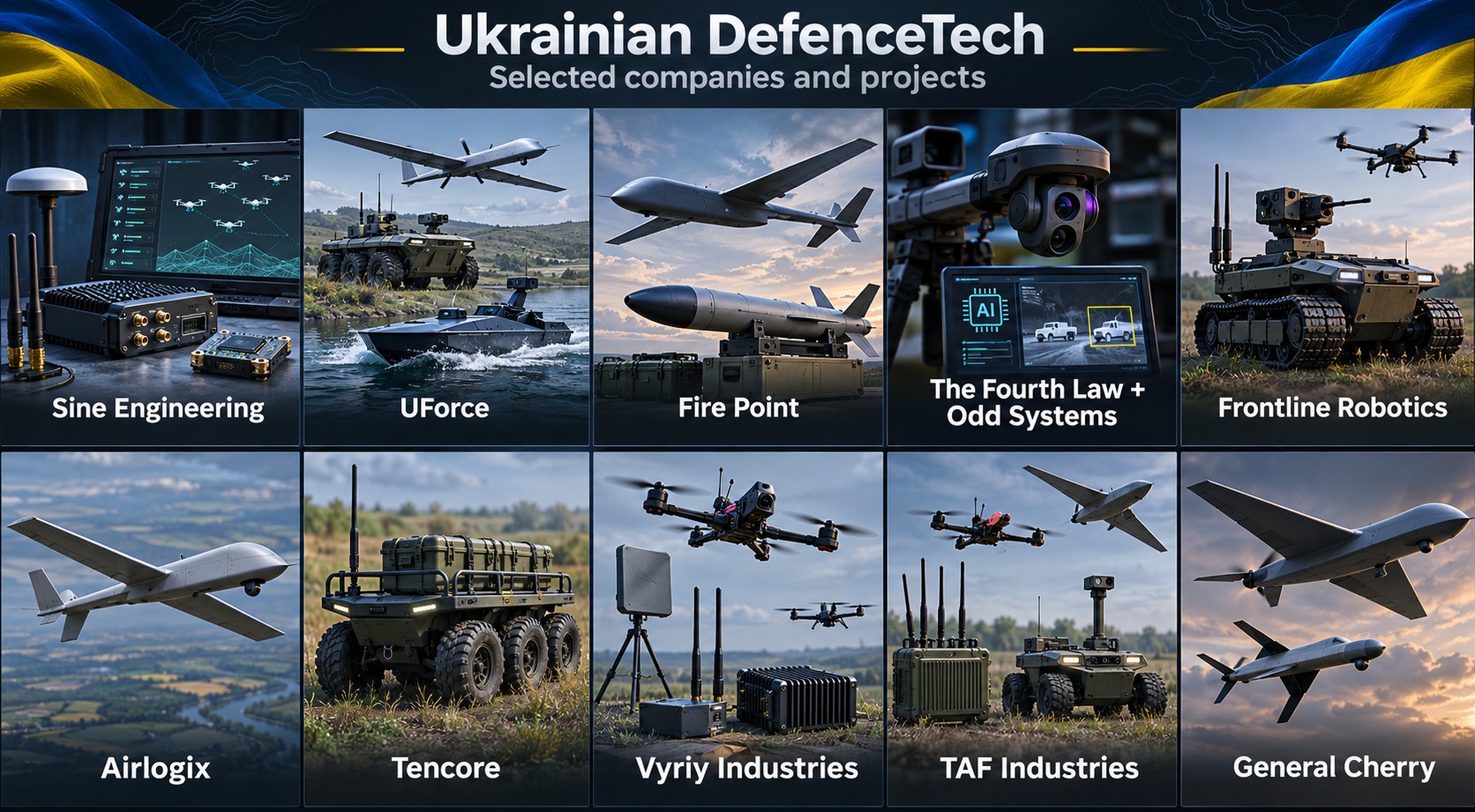
- Sine Engineering — secure communications, GPS-denied navigation, and the coordination of drone groups. Its technologies are used by more than 200 UAV manufacturers. The company already has a strategic partnership with the US-based Red Cat.
- UForce — a scalable defense platform focused on autonomous systems. It raised $50 million at a valuation exceeding $1 billion.
- Fire Point — Ukrainian long-range strike systems and missile technologies. An example of the move from drone manufacturing to more sophisticated defense platforms.
- The Fourth Law and Odd Systems — autonomy, AI, thermal imaging cameras, and optics. A combination of software intelligence and proprietary hardware components.
- Frontline Robotics — aerial and ground robotic systems. A promising field in which robots replace humans in dangerous operations.
- Airlogix — unmanned aerial systems with potential military and civilian applications.
- Tencore — ground robotics. More than 4,000 platforms have been delivered to the front, and its products are used by over 50 brigades.
- Vyriy Industries — large-scale drone manufacturing and development of proprietary technology components.
- TAF Industries — drones, electronic warfare systems, interceptors, and unmanned ground systems.
- General Cherry — strike drones and interceptors, with products used by more than 200 military units.
To me, these represent ten examples of different investment models, from AI and software to robotics, secure communications, manufacturing, and sophisticated defense systems.
I am especially interested in companies that can scale Ukrainian technologies through joint ventures with Europe and the United States while retaining their own intellectual property.
I want the next Ukrainian DefenceTech unicorns to emerge not from selling our technologies abroad, but from building global companies with Ukrainian roots. And those are exactly the companies we want to identify as early as possible.
Ukraine has already proved it can create world-class defense technologies. Now our task is to prove that we can build world-class companies. I want Ukraine to be known in ten years not only as a country that stood firm, but also as a country that created a new generation of global technology leaders. And I want the world's largest defense corporations to come to Ukraine not merely to buy technologies, but to build joint companies, manufacturing operations, and research centers here. We must turn Ukraine's technological advantage into Ukrainian enterprise value. That is our next major investment opportunity.