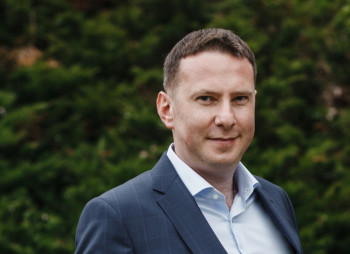
According to Vladyslav Rashkovan, Ukraine's representative at the IMF, private capital could account for 75–85% of the financing needed for Ukraine's reconstruction, with total recovery needs estimated by the World Bank at $588 billion. However, attracting investment on this scale will require not only international support but also structural reforms, protection of property rights and the development of high-quality, bankable investment projects.
Vladyslav Rashkovan, Alternate Executive Director for Ukraine at the International Monetary Fund, discussed the future financing model for Ukraine's reconstruction, instruments for attracting private capital and promising investment opportunities in an interview with Interfax-Ukraine.
He also explained how Ukraine plans to secure the necessary budget financing in 2027–2028, and the potential role of frozen Russian assets and international financial instruments.
InVenture presents an abridged version of both parts of the interview, focusing on investment opportunities and the economic aspects of Ukraine's recovery.
$588 Billion for Ukraine's Reconstruction: Where Will the Funding Come From?
— Imagine the war has ended. Ukraine faces enormous budget and trade deficits, while the World Bank estimates its reconstruction financing needs at $588 billion. Where will this money come from? Will international partners continue providing financial support?
— Financing must be considered as part of a broader reconstruction model and institutional architecture.
Reconstruction is not a task for a day or several months. It will take decades, if not generations. It cannot be accomplished overnight: the necessary institutions must be planned and established in advance.
Reconstruction requires certain preconditions. The IMF program, which focuses on macrofinancial stability, is one of them, as long-term investment cannot be planned on unstable foundations. Security guarantees would also help attract foreign investors.
Is ending the war a prerequisite for starting reconstruction? Not necessarily. We are already rebuilding despite the war. Not on the scale we would like, but billions of dollars have already been spent on recovery.
We need grants and investments more than loans and guarantees. The IMF is also emphasizing this point. At the same time, each type of financing has its appropriate role and timing.
Another fundamental principle is Ukrainian ownership of the process. No one else will develop a vision for Ukraine's future on our behalf.
The IMF ensures ongoing macrofinancial stability by preventing high inflation, sharp currency depreciation, and crises in the banking sector, public finances and balance of payments. However, this is only the foundation for further development.
Ukraine Faces a $32.6 Billion Budget Financing Gap in 2027
— Will Ukraine be able to secure the necessary external financing in 2027?
— Ukraine's 2027 budget includes $52.5 billion in non-military financing needs. Of this amount, $20 billion has already been secured, or at least financing assurances have been obtained under existing support mechanisms.
Finance Minister Serhiy Marchenko identified a $32.6 billion shortfall in financing for non-military expenditures.
The IMF estimates Ukraine's external budget financing needs for the coming year at $30–35 billion.
Ukraine and the IMF are working together to mobilize funds from international partners. This is how the system has operated throughout the war.
I believe approximately one-third of these funds will come from non-European countries, primarily Japan, as well as the United Kingdom and Canada. The Nordic and Baltic countries are also prepared to support Ukraine.
Various instruments are being considered, including guarantees, World Bank trust funds and the SPUR instrument with its multiplier effect.
Most of the funding is expected to come from the European Union, and EU officials understand this.
It is important to distinguish between different financial instruments. For example, the €50 billion Ukraine Facility and the €90 billion Ukraine Support Loan (USL) have different structures.
Pillar 1 of the Ukraine Facility, which provides budget support, is a repayable loan with financing costs. The Ukraine Support Loan is a conditional liability that is effectively cost-free for Ukraine, as international partners cover the associated expenses. Ukraine is required to repay these funds only after gaining access to Russian assets or receiving compensation or reparations from Russia.
Frozen Russian Assets as a Source of Financing for Ukraine
— What other sources of financing are available? Could Ukraine secure additional funding through frozen Russian assets?
— I am confident that Russian assets will remain a central issue for us, both now and in the future.
Most of these funds are currently held in Belgium at the international securities depository Euroclear.
The ERA mechanism was established using revenues generated by frozen Russian assets, enabling Ukraine to receive $50 billion. Formally, these are conditional loans serviced through income from the assets, but in practice they represent unconditional, effectively cost-free financing for Ukraine.
New financing mechanisms are now being considered, including ERA-2 and an expansion of the Ukraine Support Loan.
ERA-2 would again be a financial engineering instrument based on projected future cash flows. While the original ERA mechanism used a 30-year calculation period, we could now develop a model extending over 50 years.
The average yield on invested frozen Russian assets currently stands at 2.8%. Assuming an expected return of 4% in the model would generate additional income.
Through this approach and financial engineering, approximately $20 billion could be mobilized for Ukraine.
The second option is to increase the Ukraine Support Loan ceiling. The instrument and its legal framework already exist; the borrowing limit simply needs to be raised.
The European Union would need to raise additional funds on the capital markets. Therefore, it is important to ensure that the financial burden is shared among G7 partners.
Financing Ukraine Beyond 2027
— What will happen to financing in 2028, when the current support programs expire?
— The IMF and international partners are currently more focused on 2026–2027, although the IMF program with Ukraine runs through 2029.
Even if the war ends in 2027, this does not mean that public finances will return to normal in 2028.
Taking 2028 into account, the total additional financing requirement for budget expenditures is estimated at approximately $50–55 billion: $30–35 billion in 2027 and another $20 billion in 2028 and early 2029.
In 2028, the European Union's new multiannual budget framework covering the period through 2034 will take effect. The current draft allocates €100 billion for Ukraine.
It is not yet entirely clear whether this funding will be dedicated solely to budget support or will also cover reconstruction. Reconstruction will require significantly more resources, although I am confident that most of the financing will come from private capital.
Private Capital Could Provide Up to 85% of Reconstruction Financing
— What should Ukraine's model for attracting investment and financing reconstruction look like?
— There is an initiative called the "Economy of the Future" aimed at developing a broader vision for the country. Another important discussion concerns the Prosperity Plan: what Ukraine should become after the war and how much financing and investment would be needed to transform it into a new European economic tiger.
However, neither the Prosperity Plan nor the Economy of the Future is yet a Marshall Plan. These are ideas that still need to be developed. Money alone is not enough: Ukraine needs an institutional architecture capable of supporting reconstruction across several political cycles, both domestically and in partner countries.
If Ukraine is moving toward European Union membership, reconstruction should be planned according to EU standards. We already have numerous regional and sectoral strategies, but they need to be aligned.
The next question is financing. A range of instruments is already available:
-
The Pillar 2 investment component under the Ukraine Facility;
-
The €1 billion European Flagship Fund for the Reconstruction of Ukraine, managed by Dragon Capital and Amber Infrastructure;
-
Projects supported by DFC and IFC;
-
Financing from the European Investment Bank (EIB) and the European Bank for Reconstruction and Development (EBRD);
-
The Co-Investment Platform, which brings together 19 development finance institutions from different countries.
All these instruments are working for Ukraine, but we are still far from the scale required.
We must understand that the probability of receiving the entire $588 billion from international partners' public funds is zero. Historical experience suggests that 75–85% of the financing will come from private sources.
Private investment typically arrives much later than donor funding. That is why we currently rely more heavily on donor resources, but this will not always be the case.
To attract private capital, Ukraine must implement structural reforms, protect property rights, and continue land and anti-corruption reforms.
Private investment does not flow simply because foreign governments instruct it to do so.
The Czech Republic and Poland attracted most of their private investment before joining NATO and the EU, driven by strong investor expectations. If international investors expect Ukraine to join the EU and we maintain the pace of reforms, a similar process could take place here, especially amid the trend toward friendshoring — relocating production and procurement to geopolitically aligned countries.
Who Will Be the Main Donor for Ukraine's Reconstruction?
— In your opinion, who will become the main donor?
— I do not think there will be a single source of financing, as there was under the Marshall Plan. Today, there are many more financing channels and instruments.
However, this diversity could create chaos and inefficiency. Large-scale initiatives such as post-war reconstruction require careful coordination among international partners.
At the international level, the Ukraine Donor Platform already exists. Its 18th meeting is being planned, with representatives of 25 countries and nearly ten international financial institutions expected to participate.
So far, the platform has focused more on budget financing than reconstruction, but it could become a foundation for future reconstruction planning.
Its main weakness is the lack of decision-making authority. It primarily serves as an information-sharing platform.
I am working toward transforming it into an institution similar to the Economic Cooperation Administration, which operated during the Marshall Plan.
Such an agency could coordinate reconstruction, consolidate international expertise, operate with its own budget and finance technical assistance. This would help prevent duplication of expenditures and improve the efficiency of resource allocation.
Ukraine Needs Bankable Investment Projects, Not Just Ideas
— Which Ukrainian institution should play the leading role in reconstruction?
— Ukraine already has the Agency for Restoration. Our initial approach was based on two principles: there should be a central institution where experts focus on reconstruction planning, and it should operate independently of individual ministries, ideally reporting directly to the prime minister.
The intention was certainly not to establish a construction company. Actual construction should be carried out by the private sector.
At the same time, the Ministry of Economy is working on establishing Project Preparation Facilities (PPFs).
This is the right direction: we need to move from ideas and aspirations to investment-ready projects at the local level.
Reconstruction is not about dreams. It is about well-developed projects that have undergone feasibility studies and are capable of attracting financing from banks or private equity funds.
After all, reconstruction will largely depend on private capital. I would like to see PPFs develop more rapidly.
Meanwhile, with support from the World Bank and the EU, Ukraine is implementing Public Investment Management (PIM) reform. The reform aims to ensure transparency and prioritization of public reconstruction investments, as well as coordination among ministries, local authorities and international partners.
Ukrainian Regions Must Develop the Capacity to Work With Investors
— How important is the involvement of local communities and authorities?
— It is extremely important. Reconstruction is inherently local.
To rebuild cities across the country, we need to train thousands of specialists in the regions. These professionals must be able to identify needs, transform them into concrete projects and negotiate with donors and investors.
Eastern, southern and central Ukraine will have the greatest reconstruction needs. These regions require professionals who can communicate effectively with international investors and development partners.
Today, most such specialists are concentrated in Lviv, Kyiv, Odesa, Dnipro and Kharkiv.
Training has already begun. The Kyiv School of Economics and the World Bank have launched the I_CAN project, alongside other educational initiatives.
We have discussed the idea of ensuring that every municipality develops a set of necessary competencies through training and certification programs. International partners would then know that qualified professionals are available locally to manage investment projects.
Equally important is the establishment of an Accountability Framework. Long-term, multi-level financing requires mechanisms to prevent misuse of funds and ensure that resources are used efficiently.
What Is Preventing Ukraine From Attracting Large-Scale Investment Today?
— Businesses argue that investing in large-scale reconstruction makes little sense without an end to the war and security guarantees. When could the necessary conditions emerge?
— If we do nothing and simply hope that events will naturally lead to a positive outcome, it will not happen.
The challenges are so significant that they require enormous and, most importantly, coordinated efforts.
Work is already underway in each of the key areas: security, reconstruction financing, European integration, institution-building, anti-corruption measures and coordination.
The problem is that many of these processes are taking place separately when they should be interconnected.
Ukraine must simultaneously maintain macrofinancial stability, carry out immediate recovery efforts, establish institutions for large-scale reconstruction and modernize its economy.
Ukraine Lacks Large Investment Projects Worth $50 Million or More
— What objectives should the next Ukraine Recovery Conference, URC 2027, address?
— I consider the URC an important coordination instrument.
At the conference in Gdańsk, organizers tried to bridge the gap between the intimidating overall figure of $588 billion and the specific projects that make up this amount.
I am also working on this with Oksana Markarova, the presidential adviser on reconstruction and investment attraction.
Today, there are many projects worth $2–3 million, but almost no projects worth $50 million.
One of the initiatives currently under development is the creation of a new city, which could become a major investment project.
Building New Cities in Ukraine: Up to 85% of Financing Could Come From Private Capital
— So the idea of building new cities in Ukraine, which you have recently been promoting, falls into the category of large-scale investment projects?
— Yes. Since reconstruction takes place at the local level, I believe the idea of building new cities is promising.
At the city level, we can implement distributed renewable energy systems, modern infrastructure solutions and universal accessibility principles.
Starting from scratch also allows us to integrate technologies for efficient urban management, including the rational use of water and electricity, waste management and transportation systems.
I would like to create a self-sufficient city that does not require additional funding from Kyiv, generates its own jobs and becomes a magnet for talent and businesses — an example of deregulation and a favorable investment climate.
We are also working with Finnish and Korean partners on the concept of a two-level secure city.
— How far has this project progressed?
— An international team of German, Italian, French and Japanese architects is working on the city's design. We coordinate our efforts every week.
So far, all of them are working on a voluntary basis. To professionalize the project and link it to a specific location, funding from international organizations will be required.
The European Commission has shown interest in the idea as a demonstration project, since Europe itself has little recent experience in building entirely new cities of this kind.
Oksana Markarova plans to present the initiative at the World Economic Forum in Davos and at the Ukraine Recovery Conference in Tallinn, potentially even showcasing a physical scale model of the city.
I am optimistic about the project's prospects. It will require government support, but 80–85% of its financing is expected to come from private capital, investments, commercial loans, private equity funds and other financial instruments.