Ukraines mergers and acquisitions market recorded a 94% increase in disclosed deal value. Foreign investors stepped up acquisitions of Ukrainian assets, while key investment sectors included technology, agriculture, manufacturing, energy and defence technology.
Ukraines M&A Market Nearly Doubles in Deal Value
In January–September 2026, the total disclosed value of mergers and acquisitions (M&A) involving Ukrainian companies and investors reached $2.139 billion, up 94% from $1.103 billion in the corresponding period of 2025.
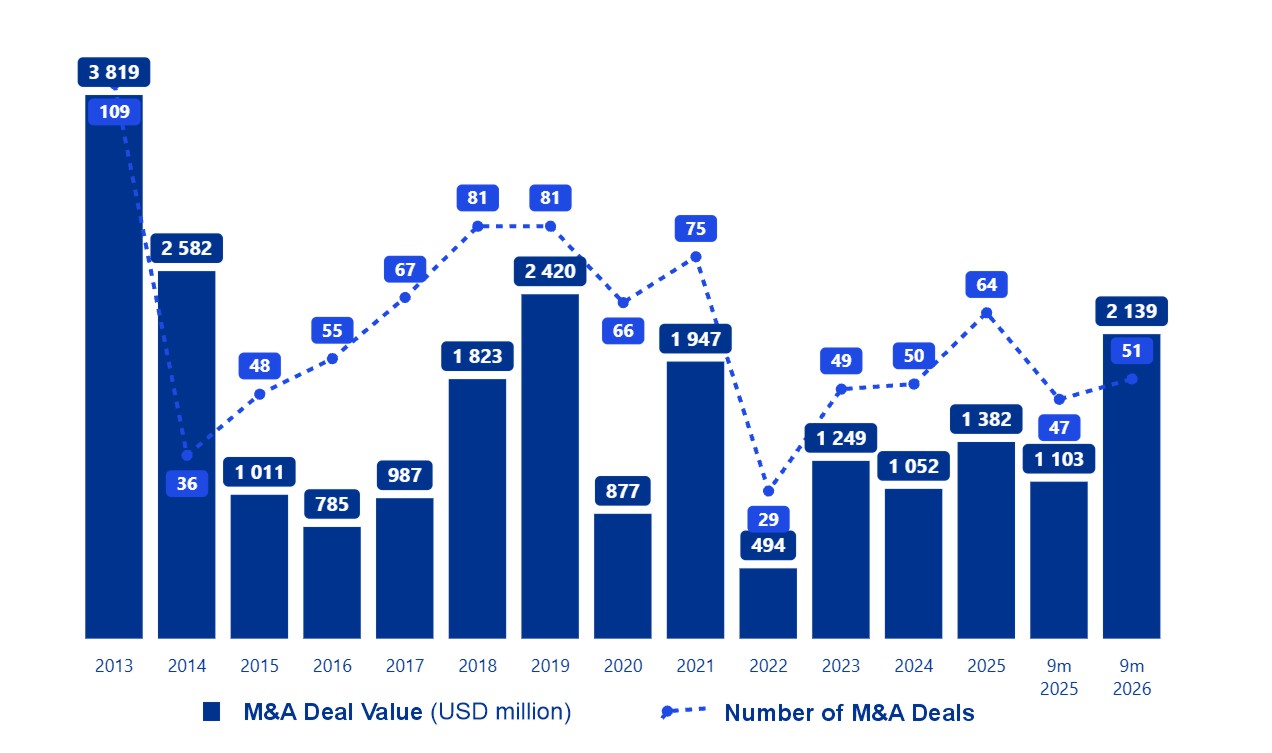
Ukraines M&A Deal Activity, 2013–2026 (First Nine Months)
The number of recorded transactions increased much more moderately, from 47 to 51 deals, representing growth of 8.5%. The defining feature of the market was therefore not so much an increase in transaction volume as the emergence of major deals capable of significantly influencing overall market statistics.
Particularly notable developments included increased activity among foreign buyers of Ukrainian assets, further consolidation in agribusiness, growing investment in renewable energy, and the scaling of defence technology companies.
At the same time, the headline financial growth figures conceal a more complex picture. The market remains selective, with a significant share of transactions concentrated among a limited number of major investors. War-related risks, financing costs and the availability of high-quality assets continue to shape investment decisions.
Key Indicators of Ukraines M&A Market
| Indicator | 9M 2025 | 9M 2026 |
|---|---|---|
| Number of deals | 47 | 51 |
| Total deal value, $ million | 1,103 | 2,139 |
| Domestic deals, number | 33 | 30 |
| Domestic deals, $ million | 733 | 527 |
| Inbound acquisitions of Ukrainian assets, number | 8 | 13 |
| Inbound acquisitions of Ukrainian assets, $ million | 41 | 1,275 |
| Outbound acquisitions by Ukrainian investors, number | 6 | 8 |
| Outbound acquisitions by Ukrainian investors, $ million | 329 | 338 |
Source: KPMG M&A Radar 9M 2026: Ukraine. Deal values have been rounded in accordance with the report.
The Impact of Mega-Deals: How Strong Is the Markets Underlying Growth?
The near-doubling of total M&A deal value warrants closer examination.
The largest announced transaction was the planned acquisition of a 100% equity stake in Ukrainian cement producer Ivano-Frankivskcement by Taiwanese industrial group TCC Group Holdings.
The estimated enterprise value of the transaction could reach €750 million, or approximately $860 million. The final consideration will depend, among other factors, on adjustments for net debt and working capital.
This single transaction accounted for approximately 40% of the total disclosed value of Ukraines M&A market in the first nine months of 2026.
Excluding this transaction, the combined value of all other deals would amount to approximately $1.28 billion, representing growth of around 16% compared with the same period last year.
Ukraines M&A market therefore continues to demonstrate positive momentum even without its largest transaction, although the underlying growth rate is considerably more moderate than the headline figure suggests.
A further comparison of the first-half and nine-month results for 2026 illustrates how strongly individual large transactions can influence market statistics.
According to KPMG, 40 deals worth $978 million were recorded in the first half of 2026. The arithmetic difference between the nine-month and first-half figures therefore amounts to 11 transactions with a combined value of $1.161 billion.
By comparison, the corresponding difference between the published figures for 2025 was 12 transactions worth just $74 million.
This represents a calculated comparison between two reporting periods rather than a separate set of quarterly statistics published by KPMG. Nevertheless, it clearly illustrates the concentration of value in major transactions announced during the third quarter of 2026.
It is also important to note that the statistics include announced transactions and estimated deal values. The value of a planned acquisition does not necessarily equal the amount ultimately paid, while the size of an investment round should not be confused with the valuation of the entire company.
Foreign Investors Return to Major Transactions in Ukraine
One of the most significant trends in 2026 has been the renewed activity of foreign capital.
The number of acquisitions of Ukrainian assets by foreign investors increased from eight to 13, representing growth of 63%. Meanwhile, their total disclosed value surged from $41 million to $1.275 billion.
As a result, transactions classified by KPMG as inbound investments accounted for almost 60% of the total disclosed value of the M&A market.
However, this growth should be viewed in the context of a low comparison base and the substantial contribution of the TCC Group Holdings transaction.
Even excluding the planned acquisition of Ivano-Frankivskcement, the value of inbound transactions would have reached $415 million — approximately ten times the figure recorded a year earlier.
This indicates that the increase in foreign investment activity extends beyond a single large industrial asset.
Most Notable Transactions Involving Foreign Capital
TCC Group Holdings — Ivano-Frankivskcement, up to $860 million. The potential transaction provides a notable example of international strategic investor interest in a major Ukrainian industrial business despite elevated war-related risks.
WestCap and other investors — Preply, $150 million. The Ukrainian-founded education technology platform raised capital in a Series D funding round, reaching a valuation of $1.2 billion. The transaction demonstrated the ability of Ukrainian-founded technology companies to attract substantial international capital through global customer bases and scalable business models.
PZU — MetLife Ukraine, approximately $100 million. The Polish insurance group agreed to acquire a Ukrainian life insurer accounting for approximately half of the relevant market. The deal illustrates investment interest in the financial sector and the consolidation of market positions by strategic players.
These transactions span different types of assets, from capital-intensive industrial manufacturing to digital platforms and financial services.
InVenture believes this diversity is particularly important. Foreign capital is willing to consider Ukrainian assets not only in the context of future reconstruction, but also on the basis of their current competitiveness, market positions, technologies and potential for expansion.
At the same time, it would be premature to speak of a broad-based return of international investors. For now, the market is primarily driven by selected strategic buyers and investment funds capable of assessing and accepting the specific risks associated with Ukraine.
Ukrainian Investors Remain the Largest Group of Buyers by Deal Count
Despite the notable increase in international activity, domestic transactions continue to form the foundation of Ukraines M&A market in terms of deal numbers.
During the first nine months of 2026, KPMG recorded 30 domestic transactions, accounting for 59% of all deals. A year earlier, there had been 33 such transactions, representing 70% of the market.
The total disclosed value of domestic acquisitions declined by 28%, from $733 million to $527 million.
Among the most notable transactions were:
-
Enselco Groups acquisition of agricultural company Agro-Region for more than $100 million.
-
Swarmers announced acquisition of ground robotic systems developer Ratel Robotics, with an estimated transaction value of $224 million.
-
Kyivstars acquisition of six solar power plants with a combined capacity of 105 MW for $80.8 million.
-
Andrii Verevskyis acquisition of a 21.44% stake in Ferrexpo for approximately $50 million.
The domestic market remains particularly important for asset consolidation, acquisitions of operating businesses and expansion of production capacity.
At the same time, a decline in the disclosed value of domestic transactions does not necessarily imply a proportional reduction in actual investment activity.
According to KPMG, deal values were disclosed for only 43% of transactions in the first nine months of 2026, compared with 60% a year earlier. Some private transactions remain undisclosed or receive market valuations considerably later.
In addition, KPMGs M&A Radar research primarily focuses on transactions with disclosed or estimated values exceeding $5 million. Consequently, a significant segment of small and medium-sized business acquisitions is not captured in the main statistics.
This is an important consideration when assessing Ukraines broader investment market. Corporate transactions worth tens or hundreds of millions of dollars shape published M&A statistics, while smaller transactions represent a separate and less transparent segment of the market.
Ukrainian Companies Continue Acquiring Assets Abroad
Alongside the development of the domestic market, Ukrainian companies continue their international expansion.
During the first nine months of 2026, eight outbound acquisitions by Ukrainian investors were announced, with a total disclosed value of $338 million. In the corresponding period of 2025, six transactions worth $329 million were recorded.
Agricultural and food group MHP remains the principal driver of this activity.
Its largest transactions included:
-
An agreement to acquire a stake in Greek meat producer and distributor Th. Nitsiakos AVEE for approximately $290 million.
-
The acquisition of Spanish company Payán Hermanos for $28 million.
Together, these two transactions represented approximately 94% of the disclosed value of all outbound M&A transactions during the period.
Meanwhile, the international acquisition activity of Ukrainian technology companies has been more diversified.
Superhuman (formerly Grammarly) acquired Portugal-based Rows.com and US-based Fathom; Holywater acquired AI studio Jeynix; Jiji acquired Bangladeshi classifieds platform Bikroy for $20 million; and SoftServe acquired Indias NewVision Software.
These transactions reflect two distinct motivations for international expansion.
For agribusiness groups, acquiring foreign assets is often associated with expanding production and distribution operations, integrating into international supply chains, and diversifying geographical risks.
For technology companies, the main drivers include expanding product capabilities, gaining access to new markets, acquiring intellectual property and adding development teams.
In both cases, M&A serves not only as a tool for business growth, but also as a mechanism for the long-term international transformation of Ukrainian companies.
Sectoral Structure of M&A: Where Is Capital Flowing?
Technology and agriculture remain the most active sectors in terms of transaction numbers.
At the same time, compared with 2025, investment interest has become more evenly distributed across different sectors of the economy.
Number of M&A Transactions by Major Sector
| Sector | 9M 2025 | 9M 2026 | Change |
|---|---|---|---|
| Innovation and Technology | 13 | 14 | +8% |
| Agriculture | 8 | 8 | 0% |
| Energy and Utilities | 2 | 5 | +150% |
| Consumer Sector | 3 | 5 | +67% |
| Industrial Manufacturing | 2 | 4 | +100% |
| Real Estate and Construction | 11 | 5 | −55% |
Source: KPMG M&A Radar 9M 2026: Ukraine. The table presents the major sectors rather than the complete sector breakdown.
These figures reveal several important trends.
First, the technology sector retains its leadership in transaction volume, although the composition of technology investments is gradually changing.
Second, agriculture maintains stable transaction activity, largely driven by the consolidation of farmland portfolios, production facilities and the international expansion of major agribusiness groups.
Third, the fastest growth in deal numbers is taking place in sectors that support the economys operational resilience, particularly energy and industrial manufacturing.
Meanwhile, the decline in real estate transactions indicates an increasingly selective approach by investors toward capital-intensive assets.
Agriculture: $428 Million in Deals and Continued Consolidation
Agriculture remains one of the largest sectors of Ukraines M&A market.
According to KPMG, eight agricultural transactions were recorded during the first nine months of 2026, with a total disclosed value of $428 million, equivalent to approximately 20% of the overall market.
The most prominent trend continues to be asset consolidation by major agribusiness groups.
A notable example was Enselco Groups acquisition of Agro-Region. The group, controlled by Andrii Verevskyi, acquired approximately 41,000 hectares of farmland under management, along with production facilities and grain storage infrastructure.
Such transactions are strategic in nature, allowing large agricultural companies to increase production scale, optimise logistics, improve the efficiency of machinery utilisation and integrate acquired assets into existing operating models.
At the same time, KPMG did not record any agricultural transactions in 2026 that fell into the category of acquisitions of Ukrainian assets by foreign investors.
This is particularly noteworthy against the backdrop of the overall increase in international M&A activity.
In our view, this situation may reflect differences in how Ukrainian and foreign buyers assess agricultural risks.
Ukrainian agribusiness groups benefit from their knowledge of the local market, established operational infrastructure, experience managing farmland portfolios and ability to integrate newly acquired businesses.
For international investors, factors beyond financial performance are also particularly important, including the remaining terms of farmland lease agreements, legal ownership structures, corporate governance, logistical risks and transparency of financial reporting.
Domestic consolidation may therefore remain an important source of agricultural M&A transactions in the near term, while the entry of international investors will depend on the availability of well-structured investment opportunities and effective risk-mitigation mechanisms.
Energy: Investments in Energy Resilience Become a Strategic Priority
The energy sector recorded the fastest growth in M&A transaction numbers among the major industries.
Five transactions were announced during the first nine months of 2026, compared with two a year earlier.
One of the largest was Kyivstars acquisition of six solar power plants in the Lviv region, with a combined installed capacity of 105 MW, for $80.8 million.
Following the acquisition, the companys total renewable energy generation capacity increased to 118 MW.
This transaction illustrates the changing role of energy assets in corporate investment strategies.
While investments in renewable generation were previously viewed primarily as standalone businesses with their own returns, they can now also serve as instruments of energy independence, diversification and operational protection.
As a result, investment interest extends beyond conventional power plants to distributed generation, energy storage systems, cogeneration, bioenergy facilities and other solutions capable of ensuring business continuity.
For industrial companies, access to independent energy supply is increasingly becoming a factor not only in operational reliability but also in the investment attractiveness of the underlying asset.
Defence Tech: Ukrainian Defence Technologies Enter a New Investment Phase
Defence technology remains one of the most dynamic segments of Ukraines investment market.
During the first nine months of 2026, KPMG recorded five defence technology transactions above the established $5 million threshold, compared with two during the corresponding period of 2025.
The largest announced transaction was Swarmers acquisition of Ratel Robotics, a developer of unmanned ground systems, with an estimated transaction value of $224 million.
Other examples included:
-
Axon Enterprises $10.4 million investment in Buntar Aerospace.
-
An $8.6 million funding round raised by startup Farsight Vision.
-
Swarmers Nasdaq listing, which raised approximately $15 million through an IPO.
-
A $50 million investment round for UFORCE, following which the company achieved technology unicorn status.
These events should be distinguished from one another: investment rounds, company acquisitions and IPOs are different forms of capital raising and should not automatically be aggregated as separate M&A transactions.
The examples illustrate the gradual transition of Ukraines defence technology sector from financing individual developments toward scaling companies and building fully fledged investment platforms.
The value of such businesses is increasingly determined not only by the availability of a finished product but also by technological expertise, intellectual property, mass-production capabilities, international partnerships and export potential.
At the same time, the sector faces specific risks related to dual-use technology regulations, export restrictions, the security of manufacturing infrastructure and corporate structuring requirements.
Actual investment activity in defence technology may be considerably broader than the statistics on large transactions suggest, as a significant proportion of early-stage funding rounds fall below the $5 million threshold.
Real Estate: Fewer Transactions as Investors Become More Selective
Unlike energy and industrial manufacturing, the real estate and construction sector recorded a significant decline in transaction activity.
Only five deals were recorded during the first nine months of 2026, compared with eleven a year earlier.
However, this trend does not automatically indicate a decline in the investment attractiveness of the entire commercial real estate market.
KPMGs figures primarily reflect major corporate transactions and do not capture a significant number of sales involving individual commercial properties, land plots, warehouses, industrial complexes and other real estate assets.
In our view, the key investment criteria for commercial properties today remain predictable cash flow, creditworthy tenants, transport accessibility, energy independence and the potential for alternative uses.
For development projects, additional considerations include implementation timelines, access to financing and the ability to phase capital expenditure.
The decline in large real estate M&A transactions therefore reflects a more complex investment decision-making environment rather than providing a definitive assessment of the entire market.
Macroeconomic Constraints: Why Investors Remain Cautious
Despite renewed activity among major investors, Ukraines macroeconomic environment remains challenging.
According to the figures cited by KPMG, annual inflation accelerated to 8.1% in August 2026, while the National Bank of Ukraines key policy rate reached 16%.
High capital costs limit financing opportunities, particularly for companies planning acquisitions that rely on debt financing.
Meanwhile, the European Bank for Reconstruction and Development forecast Ukrainian economic growth of just 1.5% in 2026, while the National Bank of Ukraine expected real GDP to increase by 1.8%.
Business sentiment also remained subdued: the Business Activity Expectations Index stood at 48.2 points in September, below the neutral threshold of 50.
Key risks for investors continue to include security conditions, labour shortages, damage to energy and logistics infrastructure, production input costs and unstable export routes.
Under these circumstances, investment decisions increasingly depend on the ability of individual businesses to generate predictable financial results even in adverse external conditions.
New Investment Funds Lay the Groundwork for Further M&A Activity
New investment initiatives remain an important positive signal for the Ukrainian market.
In particular, Dragon Capital and Horizon Capital are working to raise capital for new investment vehicles with a combined target size of approximately $750 million.
Separately, Dragon Capital announced plans to invest at least $1.1 billion in Ukraine over the next five years.
Other initiatives include:
-
$50 million — a direct investment programme by the Ukraine-Moldova American Enterprise Fund focused on Ukrainian small and medium-sized businesses.
-
€100 million — a planned defence technology fund involving Final Frontier and Myriad Defence Fund, focused on Ukraine and the Nordic countries.
-
More than €1 billion — the combined value of investment and commercial agreements announced following the Carpathian Eight Summit in the energy, transport and infrastructure sectors.
At the same time, target fund sizes, announced investment plans and commercial agreements should not be equated with capital already invested.
The actual impact of these initiatives will depend on fundraising timelines, the development of investment pipelines, the completion of due diligence and the execution of individual transactions.
Nevertheless, the emergence of new financing instruments increases potential demand for investment-ready companies and assets.
What Do the 2026 Trends Mean for Business Owners and Investors?
An analysis of M&A market results for the first nine months of 2026 highlights several practical conclusions.
First, demand for large, high-quality assets remains in place. Major industrial, agricultural and technology companies can remain attractive to strategic investors even during wartime, provided the acquisition offers a clear economic or strategic rationale.
Second, buyers favour businesses with proven financial performance and operational resilience. Transparent financial reporting, predictable EBITDA, strong corporate governance, verified ownership rights and effective risk management are becoming essential elements of transaction preparation.
Third, strategic buyers are playing an increasingly important role. Companies already operating in the relevant sectors can generate additional value from acquisitions through synergies, economies of scale, shared logistics, customer bases and the utilisation of production infrastructure.
Fourth, professional pre-sale preparation is becoming increasingly important. In a selective market, business owners must be prepared not only to justify their asking price but also to substantiate financial performance, ownership structures, liabilities and growth opportunities.
Fifth, the market is gradually diversifying. Alongside traditional agricultural and technology assets, investment attention is increasingly turning toward manufacturing, energy infrastructure, defence technologies and businesses capable of meeting critical economic needs.
For business owners, this creates opportunities both for full company sales and for attracting strategic partners or growth capital.
For investors, Ukraines M&A market remains a high-risk environment, but it also offers assets with potential competitive advantages, consolidation opportunities and long-term growth prospects.
Outlook: What Will Shape Ukraines M&A Market in Late 2026?
The results for the first nine months of 2026 demonstrate that Ukraines M&A market remains capable of generating major investment transactions even under challenging macroeconomic and security conditions.
However, future market performance will depend not only on the availability of capital but also on investors willingness to assume risks, sellers ability to bring well-prepared assets to market and the capacity to complete transactions within acceptable timeframes.
Agribusiness, energy, defence technology, manufacturing and IT remain among the sectors that could support transaction activity in the fourth quarter of 2026 and the following year.
Meanwhile, the real estate market and traditional industrial assets are likely to continue facing selective buyer demand and stricter investment payback requirements.
The main takeaway from the first nine months of 2026 is that Ukraines investment market has not only maintained transaction activity but has also demonstrated its ability to attract substantial international capital.
However, the true measure of its recovery will not be the emergence of isolated record-breaking transactions, but a sustained increase in the number of investment deals across different sectors of the economy, including the mid-market segment.
The breadth of investment demand, access to financing and the gradual reduction of war-related risks will ultimately determine how sustainable the Ukrainian M&A markets future growth will be.
Sources and Methodology
This article is based on KPMGs M&A Radar reports for the first nine months and first half of 2026, as well as official announcements concerning individual transactions. Calculated comparisons and interpretations of investment trends have been supplemented by InVentures own analysis.