Western Ukraine became a natural destination for capital after 2022. Now, developers with a three- to seven-year investment horizon are increasingly looking for markets where recovering demand could still drive further asset appreciation. Odesa is one candidate, particularly in the segment of quality real estate near the sea.
For the owner of a development company or a private real estate investor, choosing the next site means choosing the market in which a project will be sold several years from now. Current buyer activity matters, but land acquired today will become a finished product under different competitive conditions, construction costs and financing availability.
This is the context in which Lviv and Odesa should be compared. Lviv received a powerful boost from the westward relocation of people and businesses. Odesa experienced a deeper shock, and security concerns continue to constrain its investment appeal. Nevertheless, a recovery in certain segments of Odesa’s market has already begun.
For developers, this creates an opportunity to enter the next cycle before future demand is fully reflected in the price of a particular site. Realising that opportunity depends on the acquisition price, the quality of the location and the investor’s ability to sustain a lengthy preparation period.
Why capital chose Lviv
After the start of the full-scale war, relative distance from the front line and proximity to the EU became compelling reasons to relocate to Lviv. The city combined transport links with Ukraine’s western neighbours, universities, well-developed services and an established business environment.
Ministry of Economy figures illustrate the scale of business relocation: during the first year of the full-scale war, 800 enterprises relocated under the government programme, with Lviv region receiving the largest share, at 24%.
The relocation of teams and families created demand for rental housing, while gradually settling into a new location laid the groundwork for apartment purchases. However, housing needs and purchasing power are not equivalent: many displaced families could not afford to buy property.
For developers, the combination of housing needs, economic activity and geographical advantages supported the case for new projects. As this cycle develops, increased construction activity intensifies competition for attractive sites, contractors and buyers.
For companies from Kyiv and Lviv, the next step is to assess whether another project in an established market offers a better outcome than entering a city at a different stage of recovery. A high price per square metre does not, in itself, mean a high development margin: land, construction and selling costs can absorb part of that advantage.

Borys Holdenshtein, ZEZMAN Holdings
Do you see conditions emerging for a shift in property development investment from Lviv to Odesa over the next three to five years?
I would not describe it as a direct flow of capital from Lviv to Odesa. Rather, we could see a rebalancing between western and southern Ukraine.
After 2022, Lviv received a very strong structural boost: people, companies, offices and some investment capital moved there. This naturally supported demand for housing, land and commercial real estate.
Odesa, meanwhile, found itself in the opposite position. The city’s economic potential had not disappeared — the sea, the port, tourism, a large domestic market and international connections were all still there — but every investment carried a substantial additional risk premium.
That imbalance is precisely where Odesa’s main potential lies today.
If the security situation becomes more predictable over the coming years, part of that risk premium will begin to fade. Investors will then once again compare Lviv and Odesa not only in terms of security, but also on entry price, growth potential, the shortage of quality developments and future returns.
In my view, that is what could launch a new investment cycle in Odesa.
Lviv and Odesa: differences in prices and market pace
The comparison does not support the view of Odesa as a market that has come to a complete standstill. On the contrary, its lower price base is already accompanied by a recovery.
| Indicator | Lviv / Lviv region | Odesa / Odesa region |
|---|---|---|
| Average new-build residential price in the city at the end of 2025 | UAH 58,600/m² | UAH 47,100/m² |
| Annual growth in new-build residential prices, in hryvnia terms | +6% | +19% |
| Time on market for resale apartments at year-end | 62 → 34 days | 77 → 70 days |
| Housing completed in the region in January–September | 0.76 million m² | 0.61 million m² |
| Average monthly rent for a one-room apartment at the end of 2025 | UAH 17,000 | UAH 10,000 |
Source: LUN’s 2025 year-end review.
Based on these indicators, new-build housing in Odesa was approximately 20% cheaper than in Lviv at the beginning of 2026, while resale homes spent roughly twice as long on the market. At the same time, prices in Odesa were rising faster. This supports the case for a market recovering from a lower base.
For an investment decision, it is important to distinguish between the completion of buildings started earlier and the emergence of future competing supply. Housing completion figures alone do not show how many modern coastal developments will be ready by the time a new project reaches the market.
Borys Holdenshtein, ZEZMAN Holdings
If you were choosing today between two comparable sites in Lviv and Odesa, what would determine your decision?
Today, it would be a choice between two different risk profiles. In Lviv, an investor pays more for greater predictability today. In Odesa, the investor gets a potentially lower entry price but assumes greater security risk.
So I would look beyond the price of land. Five things matter to a developer: entry cost, construction cost, the future buyer’s actual purchasing power, the project delivery timeline and the potential exit price.
Odesa has an interesting characteristic here: if risk declines, the asset could appreciate before the development cycle itself is complete.
Put simply, in Lviv today you can buy greater predictability. In Odesa, you can buy greater potential for appreciation, but with greater risk.
For ZEZMAN, therefore, the question today would not be “Lviv or Odesa?” We would ask where we can achieve the best relationship between today’s entry price and the value of the completed development in five to seven years.
What a reduction in war risk could change
The investment case for Odesa rests on the possibility of several sources of demand strengthening at the same time.
The first is deferred housing decisions. A sustained improvement in security could encourage some families to reconsider buying a larger home, moving or purchasing their first apartment. Well-designed layouts, shelters, self-sufficient building systems and established infrastructure could become significant advantages for a new project.
The second is the recovery of Black Sea tourism. Safe access to the coast and convenient transport connections could support demand for hotels, serviced apartments and seasonal homes. This would broaden the potential customer base beyond the local housing market.
For a hotel operator, a particularly important question is whether a development can operate outside the summer season. Wellness services, spas, sports facilities, events and extended stays can complement seaside holidays. Their viability needs to be assessed through a separate operating model.
The third is a potential time lag between recovering demand and the delivery of new supply. Buyers may return faster than developers can secure land, complete designs and build. If too few quality projects of the right type are available at that point, sites that have already been prepared will have an advantage.
This concerns a possible shortage of a specific product: a modern development with a high-quality environment, services and convenient access to the sea. The overall number of apartments for sale may remain substantial.

Borys Holdenshtein and the ZEZMAN Holdings team
How lasting is the demand created by the relocation of people and businesses to Lviv? Could some of that demand return to the south?
I think it is a mistake to assume that all the demand that shifted to western Ukraine will necessarily move back. Over several years, people have bought homes, children have started school, companies have opened offices, and new social and business connections have formed. Some of that relocation has already become permanent.
But capital is far more mobile than people.
Someone may continue living in Lviv but buy their next investment apartment, seaside apartment or commercial property in Odesa.
For Odesa, therefore, I see potential less in a large-scale physical return of the population than in the return of investment demand.
Those are fundamentally different things.
If the security situation stabilises, tourist flows recover, businesses gain a planning horizon of several years, and developers offer completed or nearly completed properties with management services, capital could start returning to Odesa much faster than people.
For us, therefore, migration statistics alone are not the main indicator of Odesa’s future recovery.
What matters most is when private investors once again begin to view Odesa as a place to preserve and grow their capital.
Why coastal locations have a distinct investment rationale
Developers assess a seaside site through a combination of factors: distance to the beach, access, surroundings, utilities and the ability to deliver an integrated project.
The coastline is finite, and a large site with suitable characteristics cannot quickly be replicated elsewhere. Yet proximity to the water alone does not make every plot liquid: value comes from the ability to turn the location into a product that buyers or guests are willing to pay for.
For a residential developer, this could mean entering the leisure property segment. For a hospitality company, it could mean creating a development with a managed rental offering. For a private investor, it could mean partnering with a developer and an operator, with each party responsible for its part of the project.
A three- to seven-year investment horizon: the advantage of a prepared site
Early entry allows the investment process to be spread over time: acquiring the asset, reviewing documentation, developing a concept, preparing the project and defining the conditions for starting construction.
Value creation in this model can come from three factors: improving market expectations, greater site readiness and the creation of a competitive product. The latter two depend largely on the developer’s own work.
Under favourable conditions, an Odesa asset acquired on the right terms could offer greater appreciation potential than a site in a market where growth expectations are already largely priced in.
Sovinion–Chornomorka: entering a large-scale coastal development project
One example of an opportunity to enter Odesa’s next development cycle is the apartment complex project near Sovinion presented by InVenture. The 2.1-hectare site is envisaged as part of a broader concept to transform the coastal district of Chornomorka into an area with residential, commercial, leisure and social infrastructure.
Development project for a 44,061 m² apartment complex near Sovinion, Odesa
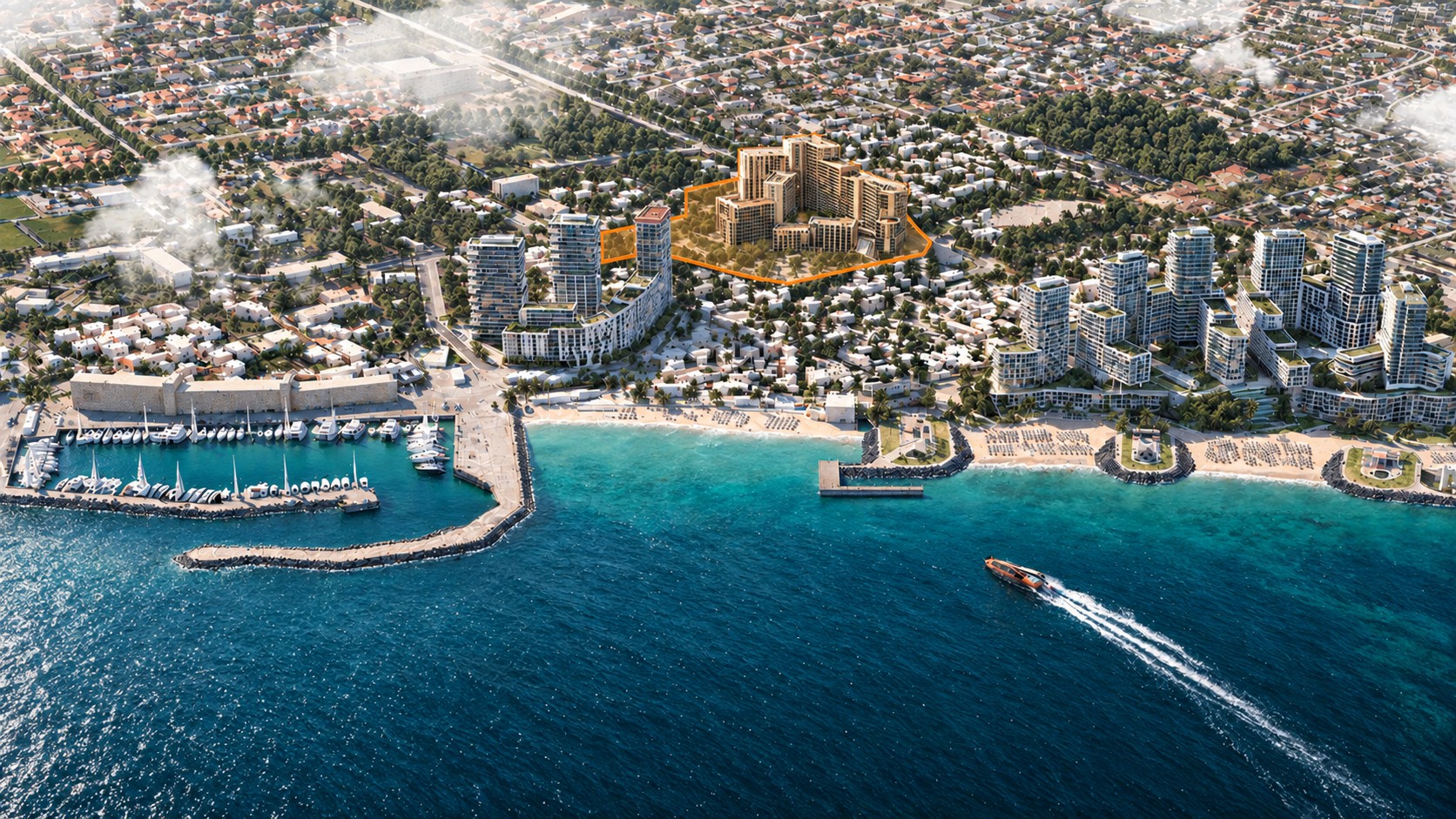
The overall concept covers 21.2 hectares with a development potential of 220,000 m², with 8.4 hectares of the site allocated to green space and landscaping. The master plan provides for public spaces, a waterfront promenade, educational and medical facilities, upgrades to the transport network and improvements to beach infrastructure.
Within this concept, investors are offered a specific asset: 2.1 hectares of privately owned land and 4,603.8 m² of existing buildings, approximately 380 metres from the shoreline. A development scenario featuring stepped buildings of up to 16 storeys envisages a total floor area of 44,061 m² and a saleable area of 37,452 m².
The investment rationale for entering at this stage is the opportunity to develop a standalone complex in a setting whose value could increase as the surrounding area develops.