For several years, Ukraine has been trying to restart large-scale investment in maritime port infrastructure through public-private partnership mechanisms. One of the most notable projects is the long-term concession of the First and Container Terminals of the Port of Chornomorsk in Odesa region.
Formally, the project looks large-scale and promising: a 40-year concession, the involvement of IFC and the EBRD in structuring the process, interest from international operators, the potential recovery of container flows, and the modernization of one of Ukraine’s key port hubs.
However, for an investor, the scale of the project is not the only important factor. Equally important are the clarity of terms, control over the asset, decision-making timelines, the predictability of the state as a partner, transparency of the procedure, wartime risks, the structure of obligations, and the ability to manage the project as one’s own long-term business — rather than merely as a temporary operator of state-owned property.
Chornomorsk Concession: A Large Project with a Long History
The idea of attracting a private investor to the Port of Chornomorsk is not new. Back in 2021, IFC and the EBRD announced cooperation with the Ukrainian government to prepare a public-private partnership for the modernization of the port. At that time, the focus was on developing the contractual framework, tender criteria, bidding rules, and engagement with potential investors.
In March 2025, the Ministry for Communities and Territories Development of Ukraine announced the decision to implement the project as a concession for the First and Container Terminals of the Port of Chornomorsk and to hold an investment conference in Warsaw together with IFC and the EBRD. At this stage, investors were expected to be presented with the key project terms and the competitive dialogue procedure.
The official announcement of the concession tender took place on December 20, 2025. The concession object includes the assets of the universal and grain maritime terminals, including property on the balance sheet of the State Enterprise “Chornomorsk Commercial Sea Port”, assets of the Ukrainian Sea Ports Authority, berths No. 1–6, as well as property to be created or constructed by the concessionaire under the agreement. The concession term is 40 years.
In April 2026, the Ministry announced the completion of the prequalification stage: several Ukrainian and international companies were admitted to the next stage — the competitive dialogue. At the same time, the number of submitted applications has not been disclosed, which the Ministry explains by the need to ensure equal conditions and fair competition.
The Main Issue: A Concession Is Not Ownership
The key feature of a concession is that the investor does not receive ownership of the port asset, but rather the right to manage and modernize it under a long-term agreement with the state. In the case of Chornomorsk, the state retains ownership of the strategic assets, while the private investor assumes obligations to modernize and operate the facility.
On the one hand, this is a standard international model for large infrastructure projects. On the other hand, for an investor, such a model always means dependence on the terms of the concession agreement, the position of the state, the regulatory environment, future legislative changes, tariff policy, investment requirements, social obligations, and potential political decisions.
In other words, the investor enters a major infrastructure project but does not receive full control over the underlying asset. The investor must take into account not only the commercial potential of the terminal, but also the state-controlled management framework that will accompany the project throughout the entire concession period.
Uncertainty of Terms and the Complexity of Competitive Dialogue
One of the key challenges for investors is that the final project model is not formed immediately, but during the competitive dialogue process. After negotiations with participants, the tender commission must prepare and submit for approval the tender conditions, instructions for participants, the draft concession agreement, and other documents for the next stage.
For a strategic investor, this means that at an early stage it is difficult to fully assess the economics of the project: the volume of mandatory investments, risk allocation, infrastructure access terms, concession payments, guarantees, compensation mechanisms, rules for revising terms, liability of the parties, and exit conditions.
These details determine the real investment attractiveness of the concession. The mere fact of access to a port terminal does not automatically mean that the project will be financially justified. In infrastructure, margins are shaped not only by cargo flows, but also by the structure of capital expenditures, tariff conditions, approval timelines, cost of financing, risk insurance, and the investor’s operational freedom.
High Competition Is Good for the State, but Not Always for the Investor
The Chornomorsk project has attracted interest from many international port operators and investors. For the state, this is a positive signal: strong competition can potentially bring better terms, a larger volume of investment, and a stronger operator.
However, from the perspective of an individual investor, high competition means something different: a more expensive entry, stricter obligations, the risk of losing after lengthy preparation, and significant expenses for consultants, legal work, financial modelling, and participation in the procedure without any guarantee of success.
For international companies, this is a standard part of working with PPP projects. But for investors seeking a more controlled entry point into Ukrainian port logistics, the Chornomorsk concession may prove to be too long, complex, and competitive a route.
The State as a Partner: Opportunities and Risks
Investment in a state port concession always involves working with several layers of the public sector: the ministry, port administration, state enterprise, local authorities, regulators, security services, environmental authorities, railway infrastructure, and other stakeholders.
For an investor in Ukrainian realities, this is undoubtedly a risk — the investor faces a large number of approvals, procedures, restrictions, and potential changes to the rules of the game.
Particularly sensitive issues include the allocation of capital expenditures, access to berths, operation of existing infrastructure, modernization of equipment, work with personnel, social guarantees, liability for wartime damage, insurance, force majeure, and future regulatory changes.
An Alternative to Concession or Privatization
Against this background, for some investors, a more understandable alternative may be not participation in a lengthy state concession tender, but the acquisition of a private land asset for the development of their own port and logistics project.
The model of private development of port infrastructure in Ukraine has existed for many years. Before the full-scale war, a number of international agricultural, trading, and logistics groups had already invested in the construction of their own or partner facilities in Ukraine’s port areas — focusing on control over logistics, transshipment, railway access, and cargo flows.
Delta Wilmar is one of the most illustrative examples of a private investor in the area of the Port of Pivdennyi. The company created a production and logistics complex that includes facilities for processing oilseeds, producing and packaging oil, as well as transshipping vegetable oils and meals. Its development demonstrates that the Pivdennyi port area can serve not only as a transshipment base, but also as a full-scale industrial and logistics ecosystem.
COFCO is an example of a Chinese strategic investor that placed its bet on Ukrainian port logistics. In 2016, the corporation officially commissioned an agricultural products transshipment terminal at the Mykolaiv Sea Port. The project cost was estimated at approximately $75 million, while the grain transshipment capacity was around 2.5 million tonnes per year.
Bunge also implemented one of the largest investment projects in port-based agricultural processing. In 2016, the company opened a new complex in Mykolaiv, which included an oilseed crushing plant and a grain terminal. It was the largest export-oriented crushing facility in Ukraine, with the complex valued in public reports at approximately $180 million.
Cargill, together with its Ukrainian partner MV Cargo, implemented the Neptune grain terminal project at the Port of Pivdennyi. The terminal was opened in 2019, has a capacity of up to 5 million tonnes of grain per year, and the project cost was estimated at $150 million. It was a joint project of MV Cargo and the American company Cargill, supported by the EBRD and IFC.
Risoil S.A. is an example of a Swiss group that has systematically invested in the port infrastructure of Chornomorsk. One of its largest terminals was designed and gradually built in the Port of Chornomorsk for the transshipment of vegetable oil and grain.
Another relevant example is Louis Dreyfus Company in partnership with Brooklyn-Kyiv. LDC operates a multi-cargo port terminal in the Port of Odesa, with a total grain storage capacity of 250,000 tonnes and potential annual grain export turnover of 4–5 million tonnes. In 2018, it was reported that Louis Dreyfus Holding B.V. was building a multimodal grain complex at the Odesa Sea Port.
These examples demonstrate an important pattern: the largest international players entered Ukraine not only through privatization or concession, but also through the development of their own or partner port facilities — with control over infrastructure, logistics, cargo flows, and the operating model. This is why a private land plot near the Port of Pivdennyi can be viewed not simply as a land asset, but as a platform for creating a new port and railway hub based on the logic already used by Delta Wilmar, COFCO, Bunge, Cargill, Risoil, and Louis Dreyfus.
A Unique Investment Opportunity Near the Port of Pivdennyi, Ukraine
Today, there is an opportunity in Ukraine to acquire a strategic land bank of 100 hectares in Odesa region, in close proximity to the TIS port hub, the Port of Pivdennyi, and the Odesa Port Plant. The asset is positioned for the development of stevedoring, logistics, industrial, and port facilities.
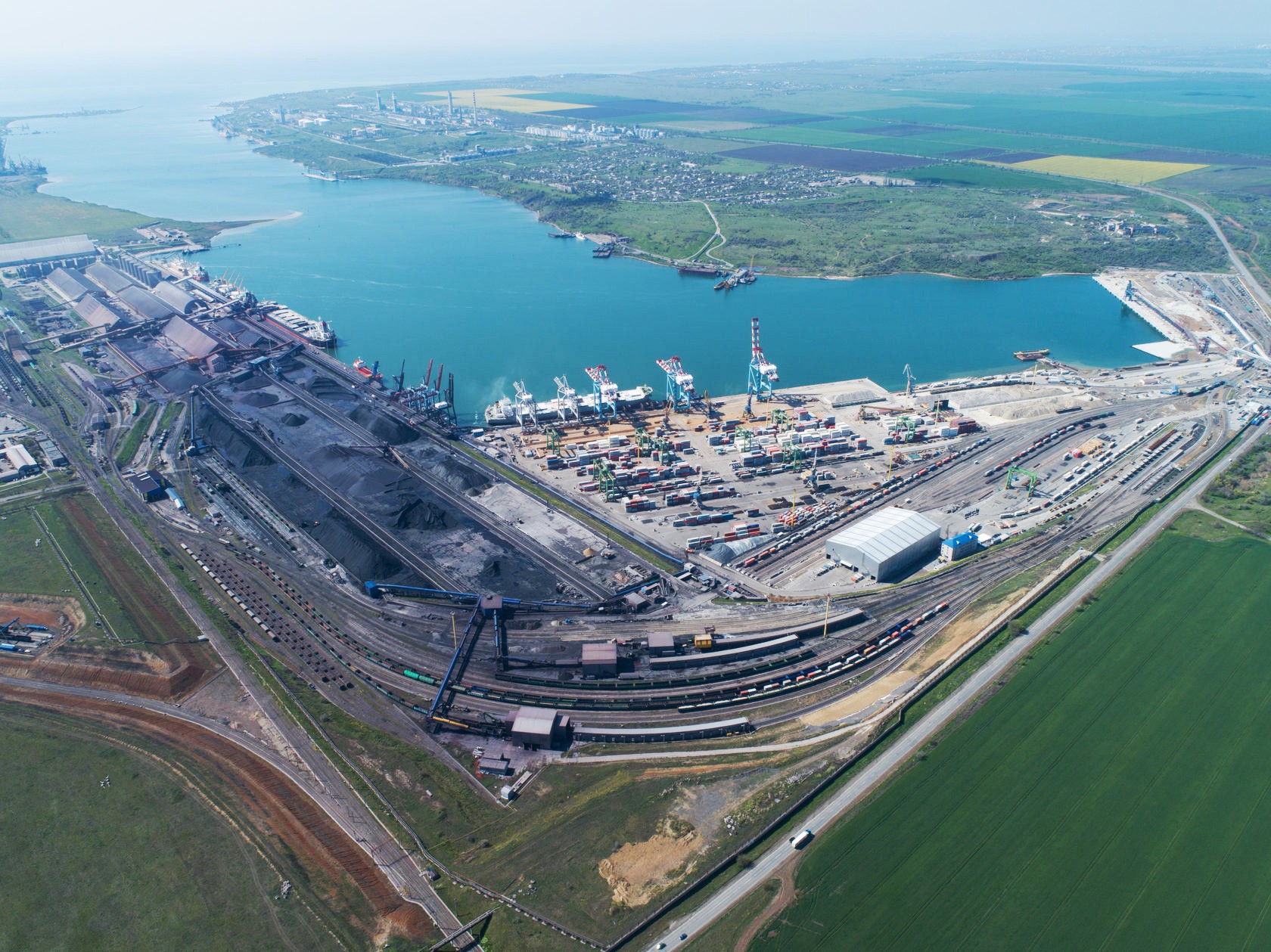
Deepwater Port and Railway Logistics Hub of 100 Hectares Near the Port of Pivdennyi
A unique strategic land bank of 100 hectares is offered for sale in close proximity to the TIS port hub, the Port of Pivdennyi, and the Odesa Port Plant for the development of stevedoring and logistics facilities.
Unlike a concession, where the investor receives the right to manage state-owned property under contractual terms, in this case the investor can view the acquisition of the land bank as a base for its own development: a dry port, railway hub, container or multi-cargo terminal, grain logistics facility, warehouse infrastructure, industrial zone, or combined port and railway cluster.
The land bank totals 100 hectares and is structured for different types of cargo flows, with the potential to operate as a single port cluster. The land bank includes: 3 hectares near the water with the possibility of forming a berth line, 56 hectares for a railway station HUB, 23 hectares for a dry port or industrial and warehouse zone, 14 hectares for a container or multi-cargo terminal, and 4 hectares for additional industrial or warehouse facilities.
The key advantage of the location is the combination of a large land bank, railway and road connections, access to water, and proximity to the largest port hub. Depths of up to 19 meters along the shoreline allow for handling Panamax / Post-Panamax vessels and also create the possibility of organizing a gallery or conveyor connection from the site to the water.
Another key factor is the approved preliminary design for the organization of a railway station HUB with a potential transshipment capacity of 10 million tonnes per year, including a railcar storage yard. This is especially important for cargo owners, traders, agricultural holdings, industrial groups, and logistics operators that need not just access to the port, but control over their own supply chain.
What the Investor Gets Instead of Participating in a Concession
The acquisition of such an asset does not eliminate the need for design work, permits, technical specifications, environmental assessment, utility connections, legal due diligence of the land, and capital investment. However, it gives the investor a fundamentally different starting profile: control over the site, the ability to independently define the concept, select partners, develop infrastructure in stages, and adapt the project to specific cargo flows.
If the Chornomorsk concession means entering an existing state-owned asset with a predefined perimeter and a complex procedure, the land bank near the Port of Pivdennyi is a development platform where the investor can create its own infrastructure model.
For some players, this could be a grain terminal. For others, a container or multi-cargo hub. For a third group, a dry port with a railway station, warehouse logistics, and industrial processing. For large international operators, this could become a platform for long-term presence in Ukrainian maritime logistics without the need to compete for a state-owned asset within a concession tender.
Investment Rationale
Ukraine’s port infrastructure will remain a strategic sector regardless of current wartime risks. The country exports agricultural products, metals, ore, and industrial cargoes, and will need to modernize its maritime logistics as part of economic recovery. Therefore, interest in Chornomorsk is understandable and logical.
However, investors should not limit their choice only to whether or not to participate in the concession. There is also a third path — to create their own port and logistics asset in the area of Ukraine’s largest maritime cargo flows.
That is why the 100-hectare land bank near the Port of Pivdennyi may be of interest as a strategic alternative to the concession project: less dependence on the tender process, greater control over the concept, the possibility of phased development, and the potential to create a private logistics cluster tailored to a specific business model.