1. Port and Maritime Logistics as a System-Forming Element of the Wartime and Post-War Economy
Until 2022, Ukraine’s port and maritime infrastructure served as the classic “backbone” of an export-driven economy. Seaports did not merely handle exports — they enabled economies of scale that allowed Ukrainian agricultural products, metallurgy, and industrial goods to remain competitive in global markets.
The war has disrupted not only physical supply chains but also the economic logic of exports. The key point, however, is that maritime logistics has not lost its relevance — it has become an object of strategic adaptation. In 2023–2026, Ukraine’s ports have effectively operated under conditions of:
-
elevated risk;
-
unstable access to international services;
-
limited investment activity;
-
while preserving the core of their operational capacity.
For the agricultural sector, this means maintaining export orientation even at higher costs. For metallurgy, it is a chance for partial recovery following the loss of traditional ports in the Sea of Azov basin. For energy and critical materials, it represents a strategic foundation for post-war integration into European supply chains.
In this sense, Ukraine’s ports in 2026 are not merely infrastructure — they are an instrument of macroeconomic resilience.
2. The Current State of Ukraine’s Port and Maritime Infrastructure in 2026
Geography of Operating Seaports
Ukraine’s port system in 2026 is characterized by profound structural distortion.
In practice, the country is operating across three distinct categories of port assets:
-
operating Black Sea seaports — the core of export logistics;
-
the Danube port cluster — a compensator and “buffer”;
-
occupied / blocked ports — a deferred asset base with high CAPEX demand.
A pivotal role is played by the ports of Greater Odesa, particularly Port Pivdennyi, which retains:
-
the greatest depths;
-
the ability to accommodate large-tonnage vessels;
-
a concentration of private terminals;
-
post-war scaling potential.
However, even these ports are operating below their technical capacity. In 2025, their effective utilization was estimated at approximately 40–50% of pre-war throughput capacity.
The Danube port cluster has become the key compensatory element. Its role has increased several-fold, yet it faces natural constraints related to depths, handling speeds, and the economics of large vessels. Danube ports are more a stabilization instrument than a long-term replacement for Black Sea hubs.
At the same time, blocked and occupied ports remain a factor of structural loss. Prolonged downtime, equipment degradation, and loss of personnel are forming a deferred investment demand for post-war recovery.
Physical Condition of Port Infrastructure
Military operations have caused systemic damage to port assets. This is not only about direct strikes on berths or warehouses, but also the cumulative effect of degradation:
-
part of the grain and container terminal capacity is operating at partial utilization;
-
dredging is performed irregularly, affecting permissible vessel draft;
-
navigational infrastructure operates under elevated risk;
-
port energy systems increasingly shift toward autonomous modes;
-
IT systems and digital solutions have been adapted to wartime operations but require large-scale modernization.
Thus, 2026 is a period of maintaining functionality rather than development. At the same time, this is precisely where the hidden investment potential lies. For investors, this means: post-war, the market will not receive “ready-made ports,” but rather ports with a latent CAPEX deficit.
Cargo Throughput of Ukrainian Ports
In 2025, total cargo throughput across Ukraine’s maritime and river ports was estimated at 60–70 million tons, representing roughly 55–60% of the pre-war 2021 level.
Cargo structure:
-
agricultural products (grains, oilseeds, processed products) — 65–70%;
-
ore and metal products — 15–20%;
-
other cargo (containers, fertilizers, construction materials, petroleum products) — 10–15%.
For comparison, in 2021 total cargo throughput of Ukraine’s seaports exceeded 150 million tons.
3. Wartime Risks and Constraints for Maritime Logistics
Security Factor
The primary risk remains the persistent threat of missile and drone attacks. This increases the cost of physical protection, reduces interest among some shipowners, and complicates the planning of logistics chains.
A separate block is insurance for vessels and cargo. War-risk premiums significantly increase freight costs, while the availability of insurance products depends directly on political and security guarantees.
At the same time, naval control and international support for maritime security play an important role, enabling the maintenance of a minimally necessary level of operational activity.
Regulatory and Institutional Constraints
Martial law implies a special regime for port operations. Some regulatory procedures have been simplified; however, at the same time:
-
restrictions remain on long-term concessions;
-
foreign investors require additional guarantees;
-
decisions are often made in a manual / discretionary mode.
Coordination between the state, port operators, and military structures has become a daily practice, but such a model is not sustainable over the long term.
4. Alternative Logistics Routes and Their Impact
The war has forced Ukraine to actively develop land and river routes. However, they are more expensive, slower, and less scalable. As a result, Ukrainian exports have partially lost competitiveness in global markets.
-
rail + road logistics + the Danube = higher cost base
-
seaports = the only scalable pathway
This experience confirmed a key conclusion: no alternative logistics system can fully replace the sea. It can only complement it during a crisis period.
5. Investment Activity in Port Infrastructure During the War
Private Operators: a Preservation Strategy
The vast majority of private port operators have adopted an “asset preservation” strategy. Investments are directed toward repairing critical nodes, ensuring autonomy, and minimal modernization.
At the same time, the market is seeing targeted investment opportunities oriented toward long-term players. One such opportunity is a 100-hectare land plot with its own rail spur and direct water access in Port Pivdennyi — an asset that enables the creation of a full-scale multimodal logistics hub with the potential to absorb hundreds of millions of dollars in post-war investment.
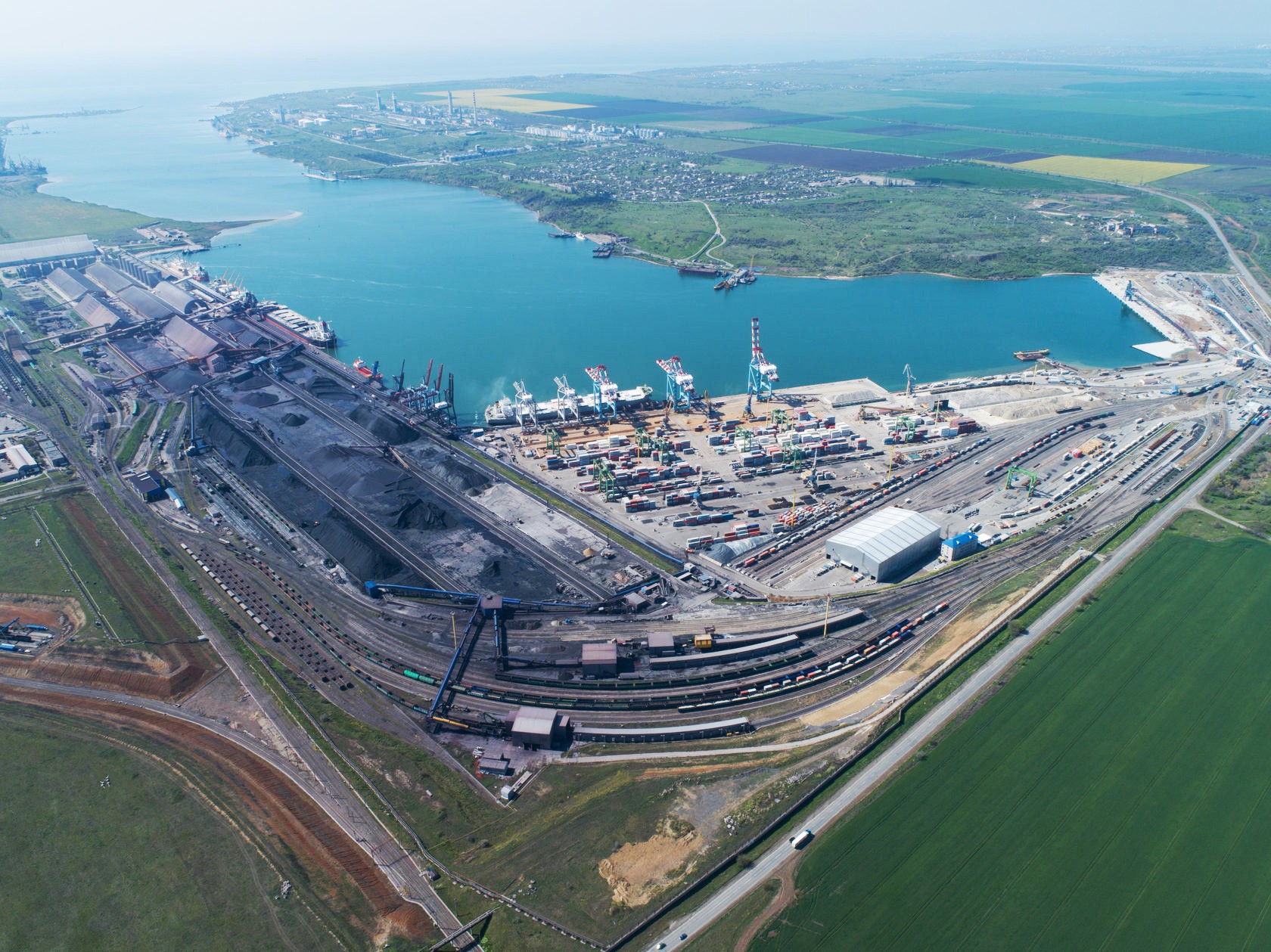
Deepwater port-and-rail logistics hub (100 ha) near Port Pivdennyi
A unique, strategic 100-hectare land package is offered for sale in close proximity to the TIS port node, Port Pivdennyi, and the Odesa Port Plant, suitable for developing stevedoring and logistics capacities.
State and International Support Programs
International financial institutions are focusing on: war-risk insurance; support for critical infrastructure; and preparing port assets for post-war concessions.
In practice, 2025–2026 has become a period of building the investment groundwork rather than active capital deployment.
6. Structural Changes in Port and Maritime Logistics
The war has accelerated transformations that in peacetime would have taken decades:
-
a shift away from concentrating flows in one or two mega-hubs;
-
development of multimodal nodes;
-
integration of inland logistics with ports;
-
digitalization and automation as a standard, not an option;
-
the growing role of security as an integral part of the investment model.
7. Post-War Outlook: Scenarios for the Development of Ukraine’s Port and Maritime Infrastructure
Base Scenario: Rapid Recovery and Scaling
Assuming a substantial and sustained reduction in security risks, within 2–3 years after the end of the active phase of the war Ukraine could shift from constrained port operations to full integration into global maritime logistics.
Key elements of this scenario include:
-
restoration of full operations of Black Sea ports, especially the ports of Greater Odesa, with the return of regular shipping and the removal of most navigational restrictions;
-
return of major shipowners and international shipping lines, including container and bulk operators;
-
cargo throughput growth to pre-war and potentially higher levels, driven by deferred demand, post-war reconstruction needs, imports, and transit;
-
Ukraine’s entry into competition for transit cargo within the Black Sea region.
In this scenario, the investment landscape changes rapidly — from the predominance of short-term capital to the arrival of institutional investors, global port operators, and large infrastructure funds with a 20–30 year horizon.
Conservative Scenario
The conservative scenario assumes prolonged partial security constraints and a slower recovery of confidence in international markets. In such a case, Ukraine’s port and maritime logistics would develop more gradually, with an emphasis on route diversification and step-by-step risk reduction.
Key characteristics:
-
preservation of the Danube port cluster’s role as an important element of export logistics;
-
slower return of major shipowners and container lines, limiting full utilization of Black Sea port capacity;
-
gradual return of institutional capital over 5–7 years, starting with lower-risk instruments such as guarantees, blended finance, and concession models backed by state or international guarantees;
-
investment focused on modernization and asset readiness rather than rapid scaling.
The conservative scenario does not imply stagnation. It forms a longer but more structured development pathway, where the key asset is not growth speed, but the quality of preparation for the next infrastructure cycle.
8. Post-War Investment Opportunities: a New Cycle of Port Capital
After the active phase of the war ends, Ukraine’s port and maritime infrastructure will enter a phase of large-scale recovery and structural renewal — closer in nature not to “repairs,” but to a reset of the infrastructure model. For investors, this means not only returning to pre-war volumes, but the opportunity to participate in shaping a new architecture of port logistics in Eastern Europe.
Port and Terminal Concessions: a Shift to Long-Term Capital
Port concessions will remain one of the key tools for attracting strategic capital. After the war, the state will be interested not only in rapid operational recovery, but also in:
-
attracting long-term operators with access to cheaper capital;
-
transferring part of operational risk to the private sector;
-
improving the efficiency of port asset management.
The next wave of concessions is expected to be qualitatively different from the pre-war period:
-
stronger focus on CAPEX commitments;
-
stricter KPIs on throughput and environmental performance;
-
integration of digital standards and security requirements.
For global port operators, this provides an opportunity to secure control over critical infrastructure in a strategic region on a 25–35 year horizon — a rare asset class in Europe.
New Terminal Construction: from Recovery to Scaling
Post-war demand for port capacity will be driven by several sources at once:
-
deferred export demand from the agricultural sector;
-
partial recovery of metallurgy and processing industries;
-
potential transit toward the EU, the Balkans, and the Middle East;
-
new cargo flows associated with national reconstruction.
In this context, the most promising segments include:
1) Next-generation grain terminals
Not simply classic elevators, but high-speed transshipment complexes, flexible storage schemes, and integration with inland logistics hubs.
2) Container terminals
After the war, Ukraine will effectively rebuild its container segment from a new baseline, with the ability to introduce automation from day one, focus on Black Sea feeder networks, and attract global lines without legacy constraints.
3) Ro-Ro and multimodal capacity
Given the rise in vehicle imports, reconstruction needs, and civil-military logistics, Ro-Ro terminals could become one of the most dynamic segments in the first five post-war years.
Dredging Projects: a Hidden Value Multiplier
Dredging is among the least visible but most capital-intensive investment areas. At the same time, it delivers a multiplier effect across the entire port system:
-
increasing allowable vessel draft;
-
reducing transport costs;
-
improving port attractiveness for major operators.
After the war, Ukraine will face the need to restore regular maintenance dredging, implement a set of capital projects in Black Sea ports, and integrate EU environmental standards. For investors, this may take the form of direct infrastructure CAPEX or concession models with guaranteed traffic.
ESG Ports and “Green” Transformation
Post-war reconstruction will take place in a different regulatory reality. European financial institutions and funds increasingly tie financing to ESG parameters.
In the port segment, this implies:
-
electrification of handling equipment;
-
shore power for vessels;
-
energy-efficient warehouses;
-
reduction of emissions and noise;
-
digital monitoring of environmental indicators.
For investors, ESG is not only compliance — it also means access to cheaper financing, a broader base of institutional LPs, and higher exit multiples.
Strategic Land-Bank Assets: Control Over Future Growth
A distinct category of opportunities comprises large land assets within or in immediate proximity to ports. Unlike existing terminals, such assets enable investors to:
-
design infrastructure “from scratch”;
-
avoid constraints of legacy solutions;
-
scale in phases in line with cargo flow growth.
This is why land-bank assets in ports are scarce and strategic.
A demonstrative example is the previously mentioned 100-hectare land plot with its own rail spur and water access in Port Pivdennyi. Such an asset provides the investor with:
-
control over a location with the deepest waters in Ukraine;
-
the ability to create a large multimodal hub;
-
phased development potential with total CAPEX reaching hundreds of millions of dollars.
For a strategic investor, this is not merely a land deal — it is an option on a dominant position in Ukraine’s post-war port logistics.
Overall, Ukraine’s post-war port cycle implies a long horizon (20–30 years), large scale, limited early-stage competition, and high upside for first movers. Investors entering at the preparation and land-banking stage will have a meaningful advantage over those waiting for full stabilization.
9. Conclusions
Port and maritime infrastructure is a foundation of Ukraine’s post-war economic recovery. Ports will become the entry point for large international capital, technology, and new logistics models.
2026 is not the end of the war for ports — it is the beginning of strategic planning for their future. Investors who enter at this stage will gain a unique opportunity to work with assets capable of absorbing hundreds of millions of dollars in the next recovery cycle.